
Bonding rubber to metal sounds simple until the wrong adhesive peels away, slides under load, or fails when exposed to water, vibration, oil, or temperature changes. Rubber is flexible. Metal is rigid. They expand differently, move differently, and often live in harsh environments. That means choosing the best adhesive for rubber to metal depends heavily on the rubber type, metal surface, and service conditions.
In this guide, we’ll explain what actually works, what fails, and which adhesive type is best for your application.
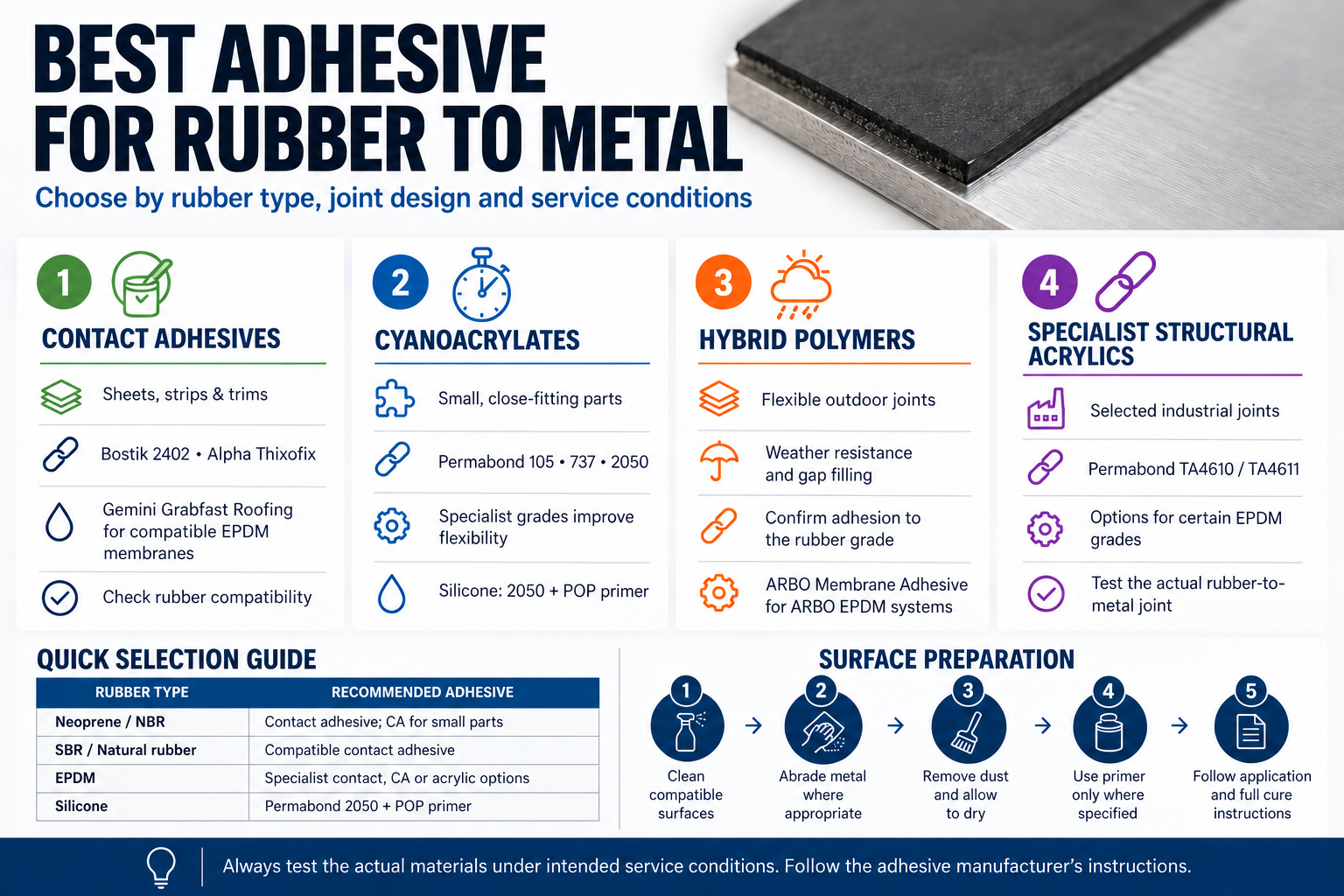
Quick Answer: What Is the Best Adhesive for Rubber to Metal?
For many industrial and trade applications, the best adhesive for rubber to metal is a contact adhesive or flexible hybrid polymer adhesive.
- Contact adhesive is ideal for rubber sheets, strips, trims, and large surface areas.
- Hybrid polymer adhesive is excellent where flexibility, outdoor weathering, or gap filling is needed.
- Cyanoacrylate (super glue) works for small, tight-fitting parts.
- Structural MMA or epoxy adhesives suit specialist high-strength engineering applications.
If bonding neoprene, nitrile, EPDM, or SBR rubber to steel or aluminium, the right preparation matters just as much as the glue.
Why Rubber to Metal Bonding Can Fail
Rubber surfaces can contain mould release agents, oils, or low-energy compounds that reduce adhesion. Metal may also be oily, oxidised, or too smooth.
Common failure reasons:
- No surface cleaning
- No abrasion of metal surface
- Wrong adhesive for flexible materials
- Bond line too thick or too thin
- Bond disturbed before full cure
- Outdoor UV/moisture exposure ignored
According to British Adhesives & Sealants Association, correct surface preparation is one of the most important factors in successful bonding systems.
How to Choose the Best Adhesive for Rubber to Metal
| Adhesive Type | Best For | Flexibility | Bond Performance | Outdoor Suitability |
|---|---|---|---|---|
| Contact Adhesive | Compatible rubber sheets, strips, trims and larger areas | Generally flexible | Strong bonds across broad, closely fitted surfaces; performance depends on rubber compatibility | Suitable grades offer good weather and water resistance |
| Hybrid Polymer | Flexible exterior joints and gap filling where rubber compatibility is confirmed | Generally high | Accommodates movement; adhesion to the particular rubber must be checked | Good with a suitable exterior grade |
| Cyanoacrylate | Small, close-fitting rubber components | Standard grades are relatively rigid; specialist grades offer improved flexibility | Fast, strong bonds in thin layers; toughened grades improve impact and peel resistance | Grade-dependent; check moisture, temperature and movement requirements |
| Specialist Structural Acrylic — TA4610/TA4611 | Selected difficult-to-bond rubbers, including certain EPDM grades, bonded to metal | Toughened; check suitability for the required movement | Useful for selected industrial joints where conventional adhesives struggle | Check the product data and test under intended conditions |
| Epoxy Adhesive | Specialist joints involving compatible rubber compounds and limited movement | Usually low; toughened grades vary | Strong on compatible substrates, but not a general first choice for flexible rubber | Grade-dependent; check water and temperature exposure |
What Type of Rubber Are You Bonding?
Different rubber materials behave very differently when bonding to metal. Choosing the wrong adhesive can lead to peeling, swelling, or bond failure.
| Rubber Type | Common Uses | Adhesive Options for Bonding to Metal |
|---|---|---|
| Neoprene Rubber | Gaskets, anti-vibration pads, seals | Bostik 2402 for sheets and strips. 105, 737 or 2050 for small, close-fitting components, subject to testing. |
| EPDM Rubber | Outdoor seals, roofing, weatherproofing | 105 or 737 for small, close-fitting parts; POP primer may be needed depending on grade. TA4610/TA4611 for selected industrial applications. Gemini Grabfast Roofing for compatible EPDM membranes; ARBO Membrane Adhesive for ARBO EPDM systems. |
| Nitrile (NBR) Rubber | Oil-resistant seals and pads | Bostik 2402 for sheets and strips. 105 or 2050 for small, close-fitting parts. Check adhesive resistance separately where oil exposure is expected. |
| SBR Rubber | General-purpose rubber sheet | Contact adhesives such as Bostik 2402 or Alpha Thixofix, subject to confirming compatibility with the particular compound. |
| Silicone Rubber | Flexible seals, gaskets, heat-resistant components | Permabond 2050 with POP primer for close-fitting joints. For high-temperature service, check the adhesive’s temperature rating separately from the silicone’s. |
| Natural Rubber | Flexible pads and trims | Bostik 2402 for sheets and strips; Permabond 105 for small, close-fitting components. |
These are starting points for product selection. Rubber formulations vary, so test the actual rubber-to-metal combination under the intended service conditions before use.
For outdoor rubber seals and flexible movement joints, hybrid polymer adhesives often outperform rigid epoxies.
1. Contact Adhesive: Best for Rubber Sheets, Strips & Large Areas
For many users, the best adhesive for rubber to metal is a solvent-based contact adhesive such as Bostik 2402. 2402 is a two part solvent adhesive designed specifically for inflatable boats and rubber including neoprene, nitrile, butyl, polyurethane and natural. For sheets, strips and trims, the best adhesive for rubber to metal may be a compatible contact adhesive such as Bostik 2402 or Alpha Thixofix.
Ideal for:
- Rubber strips onto steel frames
- Neoprene sheet to aluminium panels
- Rubber linings
- Seals and gaskets
- Marine and automotive repairs
Benefits:
- Flexible bond line
- Strong grab once joined
- Excellent for large surface areas
- Proven rubber bonding performance
See our guide on Bostik 2402 Adhesive for more details. (For more difficult to bond rubbers, read on)
Buy Bostik 2402 Rubber Adhesive
- Alpha Thixofix Contact Adhesive – a non-drip, gel contact adhesive worth considering for compatible rubber strips, trims and pads bonded to metal. Its spreadable consistency makes application easier on vertical surfaces and smaller areas where liquid adhesive could run. Confirm suitability for the particular rubber grade before use.
- Gemini Grabfast Roofing Spray Contact Adhesive – a specialist spray contact adhesive designed for EPDM roofing membranes, with metals and aluminium among its listed substrates. Particularly useful for covering larger areas quickly, offering high initial tack and a waterproof bond. Check compatibility with the particular EPDM membrane and follow the specified application instructions.
2. Super Glue: Best Adhesive for Rubber to Metal (Small Components)
For small, close-fitting components, the best adhesive for rubber to metal may be a cyanoacrylate, with toughened grades offering improved resistance to impact and vibration.
Best for:
- Small tight-fitting parts
- Fast repairs
- Bench assembly work
- Rubber feet onto metal housings
- Small seals or grommets
- Light production assembly
Example Product:
- Permabond 105 Cyanoacrylate Adhesive – a fast-curing industrial super glue suitable for bonding rubber, metal, and many plastics. Ideal where speed and neat application matter. Excellent for small rubber pads, bump stops, seals, and workshop repairs.
- Permabond 737 Black Magic Adhesive – a toughened black cyanoacrylate adhesive specifically formulated for improved flexibility and impact resistance when bonding rubber. Ideal for EPDM, neoprene, nitrile and other elastomers where vibration, movement or shock loading could cause standard super glues to fail. Offers a discreet black bond line, making it particularly suitable for automotive rubber components, seals and gaskets.
-
Permabond 2050 Flexible Toughened Cyanoacrylate Adhesive – a fast-curing, flexible adhesive suitable for bonding rubber to metal where improved peel strength and resistance to impact and vibration are important. Ideal for close-fitting rubber pads, seals, gaskets and components exposed to repeated movement. Its colourless finish offers an alternative to black toughened adhesives, while its medium-high viscosity helps control application.
–> When Should You Use POP Primer?
Some rubbers and plastics are naturally difficult for standard cyanoacrylate adhesives to bond because they have very low surface energy. A polyolefin primer (POP primer) can dramatically improve adhesion on these difficult materials. POP primer is commonly recommended alongside Permabond cyanoacrylates when bonding:
- Polypropylene (PP)
- Polyethylene (PE)
- Thermoplastic rubber (TPR)
- Thermoplastic elastomers (TPE)
- Some EPDM rubber grades
- Certain low-energy synthetic rubbers
Important: Permabond POP primer is intended for use with cyanoacrylate adhesives. It is not a universal rubber primer and should not be used as an adhesion promoter for contact adhesives, hybrid polymers, epoxies or structural acrylics. Apply it only to the surface requiring treatment, following the product instructions.
Benefits:
- Very fast fixture time
- Easy one-part application
- Strong bond on close-fitting parts
- Clean, precise application for small areas
Real World Example:
Reattaching a small rubber foot onto a metal machine cover or bonding a nitrile rubber pad onto a tool bracket where the parts fit closely together.
Less suitable for:
- Outdoor movement
- Thick bond lines
- Large flexible sheets
- Constant water immersion
- Heavy peel stress applications
3. Hybrid Polymer Adhesives: For Flexible Outdoor Bonding
Hybrid polymer adhesives can be useful for rubber-to-metal joints requiring flexibility, weather resistance and some gap filling. However, outdoor durability does not automatically mean an adhesive will bond every rubber type. Choose a product with confirmed compatibility or test the actual materials before use.
Potential Applications — Subject to Rubber Compatibility:
- External rubber trims bonded to metal
- Rubber buffers on metal doors or housings
- Flexible seals around aluminium frames
- Outdoor panel edging
- EPDM façade membranes bonded with a compatible membrane adhesive
Example Products:
- HB42 Ultimate Sealant & Adhesive – a flexible hybrid polymer adhesive and sealant for indoor and outdoor applications. An option for general bonding and sealing where adhesion to the particular rubber grade has been confirmed.
- ARBOBOND Pro Universal Adhesive – a modified polymer adhesive providing a strong, flexible bond for interior and exterior construction applications. Check compatibility before specifying it for rubber-to-metal bonding.
- ARBO EPDM Membrane Adhesive – a specialist modified polymer adhesive recommended for bonding ARBO EPDM membranes to aluminium, including polyester powder-coated finishes, and galvanised surfaces. Other EPDM grades should be checked with the manufacturer or tested before use.
Benefits:
- Flexible cured bond
- Weather resistance with suitable exterior grades
- Gap filling within the product’s specified limits
- Convenient one-part application
- Ability to accommodate movement when the joint is correctly designed
Application Example:
Bonding an ARBO EPDM façade membrane to an aluminium frame using ARBO Membrane Adhesive is a manufacturer-recommended application. Follow the specified cleaning, application and curing instructions.
Important Note on EPDM Rubber:
EPDM formulations vary, and surface oils, release agents or additives can affect adhesion. Cleaning or abrasion alone will not necessarily make an unsuitable adhesive work. Use a product approved for the membrane or rubber concerned, and confirm performance on untested grades.
Allow for Moisture Curing:
One-part hybrid polymers cure through exposure to moisture. Large, fully enclosed bond areas between rubber and metal can cure slowly. Follow the manufacturer’s guidance on bead layout, adhesive thickness and curing time before loading the joint.
For help comparing adhesive technologies, read our guide to hybrid polymer adhesives, polyurethane and silicone.
4. Structural Acrylic Adhesives: For Specialist Rubber-to-Metal Bonding
For specialist industrial applications, Permabond TA4610 and TA4611 are toughened, two-part structural acrylic adhesives worth considering for bonding certain difficult-to-bond rubbers, including selected EPDM grades, to metal.
Originally developed for low surface energy plastics, these adhesives provide an alternative where conventional adhesives struggle to achieve sufficient adhesion. Suitability depends on the rubber formulation, surface condition and movement within the joint.
Best for:
- Selected EPDM rubber components bonded to steel or aluminium
- Difficult-to-bond rubber parts requiring a two-part adhesive
- Assemblies needing more positioning time than fast-setting cyanoacrylates
- Dissimilar materials exposed to impact or changing temperatures
- Industrial applications where the specific rubber grade can be tested before production
Example Products:
- Permabond TA4610 – a toughened structural acrylic adhesive with published adhesion data for EPDM rubber. Its thicker consistency suits applications requiring controlled placement. Contains spacer beads to help maintain the bond line.
- Permabond TA4611 – a lower-viscosity alternative to TA4610, without spacer beads, making it better suited to closer-fitting joints requiring a thinner adhesive layer.
Potential Applications — Subject to Testing:
- Attaching moulded EPDM pads to metal brackets
- Bonding selected EPDM seals to steel or aluminium housings
- Securing difficult-to-bond rubber buffers to metal components
Benefits:
- Adhesion to selected difficult-to-bond rubber grades
- Ability to bond dissimilar materials, including rubber and metal
- Good impact resistance
- Room-temperature curing
- Two viscosity options to suit different joint designs
Important Note:
TA4610 and TA4611 are not universal rubber adhesives. Test the actual rubber and metal combination under representative service conditions before use. A toughened structural adhesive should not automatically be assumed to accommodate the same movement as a highly flexible rubber adhesive.
For large areas of flexible rubber sheet, strips or linings, a suitable contact adhesive may be more practical. Silicone rubber generally requires a different approach, such as Permabond 2050 with POP primer. POP primer is intended for cyanoacrylates and should not be used with TA4610 or TA4611.
Which Product Should You Choose?
Choose contact adhesive if you need to bond rubber sheet or strip onto metal.
Choose hybrid polymer if movement or weather is involved.
Choose super glue for small components.
Choose structural adhesive for engineered assemblies.
If unsure, contact us with:
- Rubber type
- Metal type
- Indoor or outdoor use
- Bond area size
- Load or movement involved
We can usually recommend the best adhesive for rubber to metal quickly.
❗ Rubber Types That Can Be More Difficult
Some rubbers are naturally lower surface energy or contain additives that reduce adhesion.
These may require specialist adhesives or testing first:
- Silicone rubber
- PTFE-backed rubber materials
- Highly plasticised rubbers
- Oily or wax-heavy rubber compounds
- Certain thermoplastic elastomers (TPE/TPR)
For these materials, specialist primers, cyanoacrylates, or structural acrylic adhesives may sometimes perform better than hybrid polymers.
Best adhesives for difficult to bond rubbers:
- Permabond 737 with POP primer
- Permabond 105 with POP primer
- Permabond TA4610
- Permabond TA4611
-
Permabond 2050 with POP primer – particularly useful for silicone rubber and other difficult-to-bond surfaces where flexibility, improved peel strength and resistance to impact or vibration are required. Apply POP primer to the difficult-to-bond surface before bonding. Suitability should be confirmed by testing, especially on highly plasticised, oily or wax-heavy compounds.
For silicone bonding you can read our guide How to Bond Silicone: 3 Powerful Permabond Solutions
Surface Preparation for Rubber to Metal Bonding
Even the best adhesive for rubber to metal can fail if the surfaces are poorly prepared.
Degrease Both Surfaces
- Use isopropyl alcohol (IPA) or a suitable cleaner
- Remove:
- Oils
- Dust
- Mould release agents
- Fingerprints
- Wax contamination
Abrade the Metal Surface
- Use 80 to 120 grit abrasive paper
- Helps create a mechanical key for the adhesive
- Particularly beneficial on:
- Aluminium
- Stainless steel
- Painted metal surfaces
Check the Rubber Surface
- Some rubbers contain release agents or surface oils that reduce adhesion
- Light abrasion can improve bonding on:
- Neoprene
- SBR rubber
- Nitrile (NBR)
- EPDM rubber
Allow Proper Cure Time
- Avoid stressing the bond too early
- Cure speed can be affected by:
- Temperature
- Humidity
- Adhesive thickness
- Airflow
Test Difficult Materials First
- Some rubbers are naturally harder to bond, including:
- Silicone rubber
- TPE/TPR materials
- Oily rubber compounds
- PTFE-backed materials
- Primer or specialist adhesives may be required
Even the best adhesive for rubber to metal can fail if oils, mould release agents or loose coatings remain on the bonding surfaces.
Final Verdict
For most practical applications, the best adhesive for rubber to metal is still a quality contact adhesive, especially for sheets, strips, and trims.
To find the adhesive for your application, test the actual materials and allow the adhesive to cure fully before assessing the bond. For rubber sheet, sponge rubber, and gasket materials, browse our full rubber materials range including neoprene, EPDM, nitrile, and SBR grades.
Good Afternoon
I wonder if you could advise an adhesive for fixing POR rubber to Stainless Steel 316 which is LOW HALOGEN
Regards
Peter Woodward