

Description
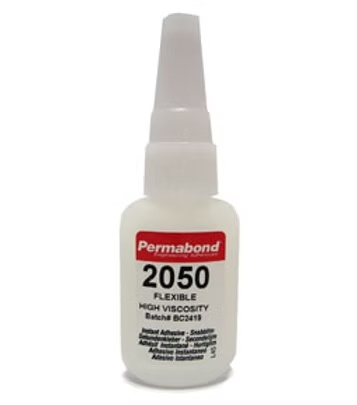
Permabond 2050 is a flexible and toughened industrial cyanoacrylate adhesive designed for applications where a standard rigid instant adhesive may not provide sufficient resistance to movement, impact or vibration.
Compared with conventional cyanoacrylate adhesives, Permabond 2050 offers improved peel strength and excellent resistance to impact and vibration. It is particularly well suited to bonding flexible or semi-porous surfaces and dissimilar materials that may experience thermal shock or thermal cycling.
Its medium-high viscosity of 1,200–1,800 mPa·s provides greater application control than very low-viscosity instant adhesives, while still offering rapid fixture times.
Permabond 2050 is also specifically recommended for silicone bonding when used with Permabond POP Polyolefin Primer.
Key Features & Benefits
- Flexible and toughened cyanoacrylate
- Improved peel strength compared with conventional CA adhesives
- Excellent impact resistance
- Excellent vibration resistance
- Fast curing
- Medium-high viscosity for controlled application
- Suitable for flexible and semi-porous surfaces
- Excellent for bonding dissimilar materials
- Suitable for assemblies exposed to thermal shock and thermal cycling
- Bonds silicone when used with Permabond POP Primer
- Maximum gap fill of approximately 0.2mm
- Single-component adhesive – no mixing required
- 100% reactive and solvent-free
- Colourless appearance
- Full strength in approximately 24 hours
What Materials Does Permabond 2050 Bond?
Permabond 2050 can be used for bonding a wide variety of materials, including:
- Rubber and elastomers
- Silicone when used with POP Primer
- ABS
- PVC
- Polycarbonate
- Steel
- Flexible materials
- Semi-porous materials
- Dissimilar material combinations
As with all adhesives, suitability will depend on the exact grade and surface condition of the materials being bonded.
Bonding Silicone with Permabond 2050
Permabond specifically recommends 2050 in conjunction with Permabond POP Primer for bonding silicone.
Silicone has a very low surface energy, making it particularly difficult to bond using conventional adhesives. Applying POP Primer to the silicone surface before Permabond 2050 substantially improves adhesion.
POP Primer is applied to the silicone surface and allowed to dry before the 2050 adhesive is applied. It is not mixed with the adhesive.
It is important to note that using POP Primer can reduce the flexibility of the finished adhesive system. Where exceptionally high elongation is required, Permabond 751 + POP may therefore be a better option.
However, where the application requires a combination of good flexibility, toughening, peel resistance and resistance to vibration or impact, Permabond 2050 + POP is an excellent choice.
For more information on choosing between different Permabond products, see our How to Bond Silicone guide.
Typical Applications
Permabond 2050 is particularly suitable for:
- Silicone bonding with POP Primer
- Rubber components
- Flexible seals
- O-rings
- Gaskets
- Flexible or semi-porous materials
- Components exposed to vibration
- Impact-resistant assemblies
- Dissimilar material bonding
- Components exposed to thermal cycling
- General industrial assembly
- Flexible components where improved peel resistance is required
Technical Information
| Property | Typical Value |
|---|---|
| Adhesive type | Flexible toughened cyanoacrylate |
| Chemical composition | Ethyl cyanoacrylate |
| Appearance | Colourless |
| Viscosity @ 25°C | 1,200–1,800 mPa·s (cP) |
| Specific gravity | 1.1 |
| Maximum gap fill | 0.2mm |
| Fixture time on steel | 10–15 seconds |
| Fixture time on Buna-N rubber | 5–10 seconds |
| Fixture time on PVC | 5–10 seconds |
| Full strength | 24 hours |
| Impact strength | 5–10 kJ/m² |
| Hardness | 85 Shore D |
| Dielectric strength | 25 kV/mm |
| Dielectric constant @ 10kHz | 2.5 |
| Thermal conductivity | 0.1 W/(m.K) |
Figures shown are typical values and should not be considered product specifications. Cure speed and final performance will vary according to substrate, temperature, humidity, surface preparation and bond gap.
Permabond 2050 Bond Strength
Typical shear strength figures include:
- Steel: 16–20 N/mm²
- ABS: >6 N/mm²
- PVC: >8 N/mm²
- Polycarbonate: >5 N/mm²
On some plastic substrates, substrate failure may occur before failure of the adhesive joint.
How to Use Permabond 2050
For best results:
- Ensure both bonding surfaces are clean, dry and free from oil, grease or contamination.
- Apply Permabond 2050 sparingly to one surface.
- Bring the components together and correctly position them.
- Hold the assembly until sufficient handling strength has developed.
- Allow the adhesive to fully cure before subjecting the joint to its maximum service load.
Full strength is typically achieved after approximately 24 hours.
Permabond 2050 is designed primarily for relatively close-fitting components and has a maximum recommended gap fill of approximately 0.2mm.
Using Permabond 2050 on Silicone
When bonding silicone, first prepare the silicone surface using Permabond POP Primer.
Apply the POP Primer to the silicone and allow it to dry before applying Permabond 2050.
Because silicone formulations and surface treatments vary, we recommend testing the complete 2050 + POP system on the actual materials before full production.
Why Choose Permabond 2050?
Permabond 2050 occupies a useful middle ground between a conventional rigid cyanoacrylate and an adhesive designed specifically for very high elongation.
Choose 2050 when you need:
Good bond strength + flexibility + toughening + peel resistance + impact/vibration resistance.
This makes it particularly useful where the joint will experience movement but doesn’t require the very high levels of elongation offered by a product such as Permabond 751.
Permabond 2050 vs Permabond 751
Both adhesives are useful for applications involving flexible materials, but they have different strengths.
Choose Permabond 2050 when:
- Improved peel strength is important
- Impact resistance is required
- The assembly experiences vibration
- You need a medium-high viscosity adhesive
- You’re bonding flexible or semi-porous surfaces
- You need a toughened flexible cyanoacrylate
Choose Permabond 751 when:
- High elongation is the priority
- The bonded material will stretch significantly
- Repeated flexing is expected
- Maintaining long-term elasticity is particularly important
For example, a silicone component that undergoes significant repeated stretching may favour 751 + POP, whereas a flexible silicone seal subjected primarily to vibration, peel forces or impact may favour 2050 + POP.
When Should You NOT Use Permabond 2050?
Permabond 2050 won’t be the best adhesive for every application.
Consider an alternative where:
- Very large gaps need filling
- A thick flexible adhesive bead is required
- The adhesive needs to behave like an elastomeric sealant
- Very large bonding areas are involved
- Extremely high elongation is required
- The substrate cannot tolerate cyanoacrylate adhesive
- Service temperatures or chemical exposure exceed the product’s capabilities
If maximum elongation and repeated stretching are the primary requirements, consider Permabond 751 instead.
For difficult low-surface-energy substrates such as silicone, do not rely on 2050 alone. Permabond POP Primer should be used to achieve suitable adhesion.
Permabond 2050 + POP Primer for Silicone
For silicone applications, Permabond 2050 and POP Primer provide a useful combination of adhesion, flexibility and toughness.
The POP Primer enables adhesion to the otherwise difficult silicone surface, while 2050 provides greater flexibility, peel resistance and impact resistance than a conventional rigid cyanoacrylate.
For applications involving particularly high or repeated stretching, consider Permabond 751 + POP Primer as an alternative.
If you’re unsure which product is best for your application, contact us with details of the substrates, bond dimensions, expected movement, temperature and environmental exposure and we’ll be happy to advise.
Important
Always test Permabond 2050 on the actual production materials before committing to full-scale use, particularly when bonding silicone, flexible substrates or unknown rubber compounds.
Surface preparation, substrate grade, bond gap and service conditions can all affect final adhesive performance.
Always refer to the latest Permabond Technical Data Sheet and Safety Data Sheet before use.


Reviews
There are no reviews yet.