
Adhesives are more than just “which glue is strongest.”
When selecting the right product for construction, roofing, manufacturing or industrial applications, understanding the adhesive technology behind the product is essential.
Different adhesive chemistries behave in very different ways. Some offer high strength, others flexibility, and some are designed mainly for sealing rather than structural bonding.
In this guide we compare three of the most widely used construction adhesive technologies:
We’ll explain how each works, where each performs best, and when one is a better choice than another. We’ll also show real examples available from Adhesive Supply Company including products from Arbo, Adlflex, HB42 and more.
What Is a Hybrid Polymer Adhesive?
A hybrid polymer adhesive combines the strength of polyurethane with the flexibility of silicone, using modern polymer chemistry to create a versatile bonding solution.
Hybrid adhesives are widely used in construction, cladding, panel installation, roofing and general trade applications because they offer a balance of strength, flexibility and weather resistance.
Key benefits of hybrid polymer adhesives include:
✔ Strong initial grab
✔ Excellent flexibility after curing
✔ Bonds to multiple substrates without primer
✔ Solvent-free and low odour
✔ Good UV and weather resistance
✔ Minimal shrinkage during cure
Hybrid polymers are ideal when bonding different materials together, such as metal to masonry, wood to steel, or plastics to concrete.
Hybrid adhesives are often chosen where both adhesion and movement tolerance are required.
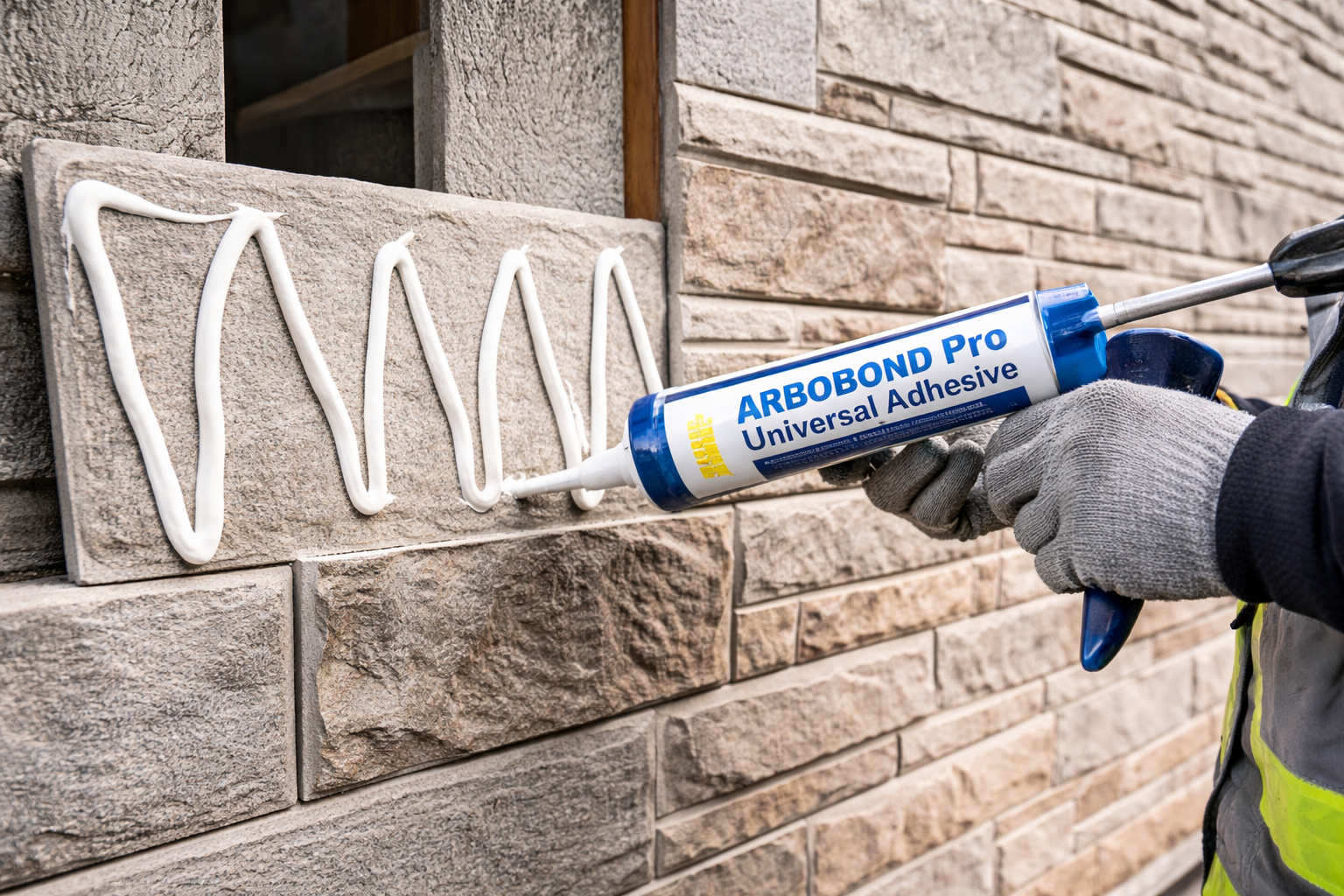
👉 Example: ARBOBOND Pro Universal Adhesive – a versatile hybrid polymer adhesive suitable for bonding metal, wood, block and other substrates. This is a cost effective hybrid adhesive which offers offers excellent initial grab, long-term flexibility and reliable adhesion across a wide range of construction materials.
Polyurethane (PU) Adhesives – Tough & Durable
Polyurethane adhesives, often called PU adhesives, are known for their toughness and durability.
They usually provide higher mechanical strength than silicone and can be more rigid than hybrid polymers once fully cured.
PU adhesives cure by reacting with moisture in the air, forming a strong cross-linked structure that resists impact, vibration and load. This makes them less flexible than hybrid polymers but stronger for certain structural tasks.
Typical uses for PU adhesive include:
-
Timber construction
-
Structural bonding
-
Heavy materials
-
Exterior joinery
-
Gap-filling applications
Advantages of PU adhesives:
✔ High strength
✔ Excellent impact resistance
✔ Good gap filling properties
✔ Strong bond to wood and porous materials
✔ Suitable for exterior use
However, PU adhesives may be less flexible than hybrid polymers and can require more surface preparation.
PU adhesives are often preferred where structural strength is more important than flexibility.
👉 Example: Adlflex PU Adhesive – a polyurethane adhesive that gives resilient bonds for construction and assembly uses.
You may also find our guide useful: Epoxy vs MMA vs PU Adhesive – Which Structural Adhesive Should You Use?
Silicone Adhesives – Highly Flexible & Weatherproof
Silicone adhesives and sealants are designed for flexibility and long-term weather resistance rather than maximum bond strength.
Silicone remains elastic after curing and performs extremely well in outdoor environments, making it ideal for sealing joints exposed to movement, moisture or temperature changes.
Common uses for silicone adhesive:
-
Window and door sealing
-
Expansion joints
-
Weatherproofing
-
Glass bonding
-
Exterior sealing
Benefits of silicone adhesives:
✔ Excellent flexibility
✔ Outstanding UV resistance
✔ Waterproof and weatherproof
✔ Long service life
✔ Good for movement joints
Silicone does not always bond as strongly as hybrid polymer or PU adhesives, especially on porous construction materials, but it performs better where movement is expected.
Hybrid sealants are often used instead of traditional silicone when both bonding and sealing are required.
👉 Example: ARBO Silicone Sealants such as Arbosil 1096 are formulated to provide excellent flexibility, weather resistance and long-term sealing performance for glazing and façade applications.
Unlike silicones, hybrid polymer adhesives will bond more readily to mixed substrates like metal, wood and masonry without primers.
Comparing Adhesive Technologies
Here’s a side-by-side comparison:
| Technology | Strength | Flexibility | Substrate Range | Weather Resistance | Best for |
|---|---|---|---|---|---|
| Hybrid polymer adhesive | ⭐⭐⭐ | ⭐⭐⭐⭐ | Metal, wood, masonry, plastics | ⭐⭐⭐⭐ | General construction, multi-substrate bonding |
| PU adhesive | ⭐⭐⭐⭐ | ⭐⭐⭐ | Wood, plastics, foam, metal | ⭐⭐⭐ | Heavy bonding, gap filling |
| Silicone adhesive | ⭐⭐ | ⭐⭐⭐⭐⭐ | Glass, ceramic, rubber | ⭐⭐⭐⭐⭐ | Movement joints & sealing |
Each adhesive type has a different role, and choosing the correct one will improve both performance and durability.
Where Each Adhesive Shines
Use Hybrid Polymer Adhesive When:
-
Bonding mixed materials
-
You need flexibility and strength
-
Working outdoors
-
You want good grab without primer
Option 1: ARBOBOND Pro Universal Adhesive
A versatile hybrid polymer adhesive designed for strong, flexible bonding across a wide range of construction materials. It offers excellent initial grab, good gap-filling properties and reliable adhesion on both dry and slightly damp surfaces. Ideal for general building, panel fixing and trade applications where a dependable all-round adhesive is needed.
Option 2: HB42 Ultimate Sealant & Adhesive
A high-performance hybrid sealant and adhesive with superior grab and enhanced flexibility. Designed for both bonding and sealing, it provides a more elastic finish, making it ideal for applications subject to movement, vibration or where a clean, sealed joint is required.
Key Difference
👉 ARBOBOND Pro = more of a true adhesive
- Better for fixing, bonding, and general construction
- Slightly more “firm” once cured
👉 HB42 Ultimate = more of an adhesive + sealant hybrid
- Better where you need movement, flexibility or sealing
- Cleaner finish for visible joints
Use PU Adhesive When:
-
Bond must be very strong
-
Bonding timber or structural parts
-
Gap filling is required
-
Impact resistance matters
Example: Arbothane 1245 600ml
For a detailed example of a high-performance polyurethane adhesive, see our guide to Arbothane 1245. This product is widely used for structural sealing and bonding applications where flexibility, durability and weather resistance are essential, making it ideal for construction joints, concrete and façade work.
Use Silicone When:
-
Joint must stay flexible
-
Weatherproof sealing needed
-
Bonding glass or ceramics
-
High UV exposure
Example: Arbo 1096 S
A high-performance low modulus neutral cure silicone sealant designed for glazing and façade applications. Customers should use Arbosil 1096 S where flexibility, weather resistance and long-term durability are critical, particularly on external joints exposed to movement, UV and moisture.
Large Surface Bonding – When Contact Adhesive Is Better
In some applications, neither hybrid, PU nor silicone is ideal.
For bonding large flat surfaces such as insulation boards, membranes or laminates, a contact or spray adhesive may be more suitable. If you’re bonding different materials, see our strongest glue for metal to plastic guide for the most reliable adhesive options.
Example:
Soudabond 250 Super Tack C&S – high strength spray contact adhesive for large area bonding.
Contact adhesives give fast coverage and even bonding across wide surfaces.
Real-World Product Recommendations
Here are practical adhesives you can buy now for specific needs:
🧰 Hybrid Polymer Adhesives
-
ARBOBOND Pro Universal Adhesive – Great all-round grab adhesive for construction materials
-
HB42 High Grab Adhesive Sealant – Hybrid sealant with adhesive performance
🔩 PU Adhesives
-
Adlflex PU Adhesive – Durable polyurethane adhesive for wood and panel bonding
🚿 Specialty Contact Spray
-
Soudabond 250 Super Tack C&S – A spray contact adhesive that’s excellent for large flat surface bonding (e.g., insulation boards, membranes)
Case Studies: When to Use What
🧱 Fixing Cladding Panels
If you’re bonding cladding panels to blockwork or steel framing with minimal movement, a hybrid polymer adhesive gives the best mix of initial grab and flexibility.
👉 Use: ARBOBOND Pro Universal Adhesive
📦 Heavy Timber Assembly
For load-bearing timber assembly (like bench frames or decking boards), a PU adhesive can deliver lasting strength and impact resistance.
👉 Use: Adlflex PU Adhesive
🪟 Window & Door Sealing
Where movement between frames and walls is constant, silicones or hybrid sealants that behave like silicones are ideal to provide a waterproof seal.
👉 Use: HB42 High Grab Adhesive Sealant
📄 Large Surface Lamination
If you need to bond large areas (roof membranes, insulation boards), a spray contact adhesive is faster and cleaner.
👉 Use: Soudabond 250 Super Tack C&S
How to Choose the Right Adhesive
Choosing the right adhesive depends on a few key questions:
-
What materials are you bonding?
Metal, wood, rubber, stone? -
Is flexibility important?
Joints with movement require different chemistry. -
Do you need initial grab or gap filling?
Spray contact vs hybrid vs PU fill-grade. -
Is the bond exposed to weather?
UV resistance and moisture resistance matter.
These questions help you pick the best technology — not just the strongest glue.
For further background on adhesive technologies and performance standards, the British Adhesives & Sealants Association (BASA) provides industry guidance and technical insight. https://www.basa.uk.com
Final Thoughts
A hybrid polymer adhesive is often the best all-round choice for construction and trade applications, offering a balance of strength, flexibility and durability.
However, polyurethane adhesives remain the best option for heavy structural bonding, while silicone adhesives are still the top choice for flexible sealing and weatherproof joints.
Choosing the correct adhesive technology for the job will always give better long-term results than using a single product for every application.
If you are unsure which adhesive to use, our technical team at Adhesive Supply Company can help you select the right product for your specific materials and conditions.