
Choosing the right high strength spray adhesive can make large-area bonding considerably quicker and more efficient, but not every spray adhesive is designed for the same application.
From bonding MDF, plywood and decorative laminates to installing upholstery, van lining or EPDM roofing membranes, the materials involved and the conditions the finished bond will experience should determine which adhesive you choose.
Industrial canister adhesives are particularly useful where large areas need to be covered quickly. Rather than manually applying contact adhesive using a brush, roller or trowel, a self-pressurised system allows adhesive to be sprayed evenly across the substrate without requiring a separate compressor.
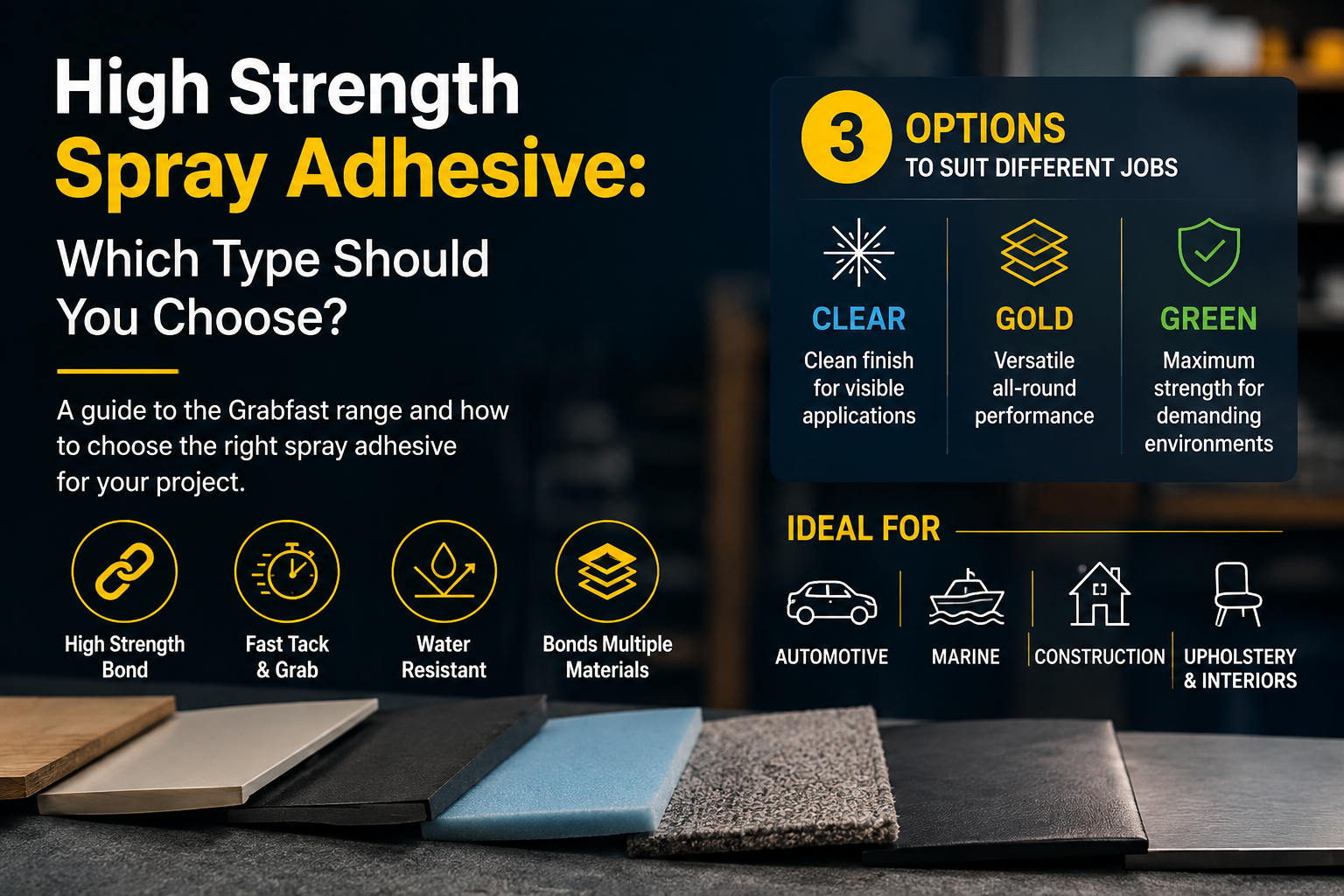
In this guide, we’ll explain how spray contact adhesive works, what to consider when choosing one and compare three Gemini GrabFast options: GrabFast Clear, GrabFast Gold and GrabFast Roofing.
What Is a High Strength Spray Adhesive?
A spray contact adhesive works differently from many cartridge adhesives, epoxies and superglues.
With a typical contact adhesive, adhesive is applied to both surfaces being bonded. The solvent is then allowed to flash off before the two adhesive-coated surfaces are brought together.
Once the surfaces make contact, the initial bond can be extremely fast.
This makes contact adhesives particularly useful for bonding larger sheets and panels where an adhesive that requires lengthy clamping could slow down production.
A spray contact adhesive takes the same principle and makes application significantly quicker. The adhesive is delivered as a controlled spray, allowing large surfaces to be covered rapidly and consistently.
Why Use a Canister Spray Adhesive?
For occasional small bonding jobs, manually applied contact adhesive may be perfectly adequate.
The benefits of a self-pressurised spray system become much more noticeable when bonding larger areas or carrying out repetitive work.
Typical advantages include:
- Fast application
- Consistent coverage
- High initial grab
- Reduced application time
- No separate compressor required
- Portable system
- Suitable for large surfaces
- Less manual spreading
- Useful in production environments
- Long open time depending on the adhesive
- Efficient application to irregular or awkward surfaces
This makes industrial spray adhesives particularly popular in joinery, furniture manufacturing, laminating, automotive interiors, van conversions, exhibitions, flooring, roofing and other fabrication applications.
Which Spray Contact Adhesive Should I Choose?
We’ve introduced three Gemini GrabFast products, each aimed at a slightly different requirement.
Quick Comparison
| GrabFast Clear | GrabFast Gold | GrabFast Roofing | |
|---|---|---|---|
| Best suited to | General-purpose industrial bonding | Premium/high-performance bonding | EPDM & roofing membranes |
| Coverage | Approx. 18m²/kg | Approx. 19m²/kg | Approx. 19m²/kg |
| Temperature stability | Up to 120°C | Up to 130°C | Up to 135°C |
| Glue solids | 32–34% | 38–42% | 38–42% |
| Spray pattern | Web | Web | Web |
| Water resistance | Water resistant | Water resistant | Waterproof |
| Typical materials | MDF, plywood, laminates, metals, GRP, rubber, fabrics, upholstery | Laminates, veneers, MDF, plywood, solid surfaces, metals, rubber and more | EPDM, TPO, TPE, rubber membranes and insulation |
| Our choice for | Everyday versatility | More demanding applications | Roofing |
So which one should you use?
GrabFast Clear: The General-Purpose Option
Gemini GrabFast Clear is the most versatile starting point of the three and is designed as a general-purpose industrial spray contact adhesive.
It can be used with a broad range of compatible substrates including:
- MDF
- Plywood
- Decorative laminates
- High-pressure laminates
- Veneers
- Wood
- Metal and aluminium
- FRP/GRP
- Rubber
- Foam
- Upholstery
- Fabric and textiles
- Carpet
- Leather and suede
- PVC and selected plastics
GrabFast Clear provides approximately 18m²/kg coverage, contains 32–34% glue solids and offers temperature stability up to 120°C.
This makes it a strong choice where you want one versatile industrial adhesive for a variety of everyday manufacturing, fabrication or installation jobs.
When Would We Choose GrabFast Clear?
We would generally start with Clear for applications such as:
MDF and plywood bonding
Ideal for joinery, furniture and fabrication applications involving larger board areas.
Van lining and automotive interiors
Useful for compatible carpets, fabrics, upholstery and interior trim materials.
Laminates and veneers
The spray system allows adhesive to be distributed quickly over large panels.
General manufacturing
A useful all-rounder where several compatible substrates may need to be bonded using the same adhesive system.
Buy Gemini GrabFast Clear Spray Contact Adhesive 22L
GrabFast Gold: The Premium High-Performance Option
For more demanding applications, Gemini GrabFast Gold steps things up.
Gold contains 38–42% glue solids, compared with 32–34% for Clear, while its temperature stability increases from 120°C to 130°C.
Coverage is also approximately 19m²/kg.
GrabFast Gold is particularly suited to applications involving materials such as:
- Decorative laminates
- High-pressure laminates
- Veneers
- MDF
- Plywood
- Solid surfaces
- Wood
- Metals
- Aluminium
- FRP/GRP
- Rubber
- Selected plastics
- Fabrics
- Carpet
Its combination of high initial grab, increased solids and higher temperature stability makes it the premium spray contact adhesive of the two general-purpose options.
GrabFast Clear or GrabFast Gold?
This is probably the question we’ll get asked most often.
For general-purpose bonding where 120°C temperature stability and 32–34% solids are sufficient, we’d normally consider GrabFast Clear first.
If the application is more demanding, GrabFast Gold offers:
- Higher glue-solids content
- Increased temperature stability
- Excellent initial grab
- High final bond strength
- Premium performance for demanding applications
Gold is particularly interesting for laminating, solid surfaces, furniture manufacturing, joinery and other applications where increased adhesive performance is desirable.
Buy Gemini GrabFast Gold High Performance Spray Contact Adhesive 22L
GrabFast Roofing: Spray Adhesive for EPDM & Roofing Membranes
The third product is considerably more specialised.
Gemini GrabFast Roofing has been specifically developed for bonding EPDM, TPO, TPE, rubber membranes and insulation.
Rather than using a general-purpose adhesive and hoping for the best, GrabFast Roofing provides a product specifically formulated around membrane and roofing applications.
It offers:
- 38–42% glue solids
- Approximately 19m²/kg coverage
- Temperature stability up to 135°C
- High initial grab
- Fast drying
- Long open time
- Waterproof finished bond
- Web spray pattern
Of the three products compared here, GrabFast Roofing also has the highest stated temperature stability.
Spray Adhesive for EPDM
EPDM roofing can involve bonding substantial areas of membrane, which is where a canister spray contact adhesive can be particularly useful.
The self-pressurised system allows adhesive to be applied rapidly across the required area without a separate compressor.
GrabFast Roofing is therefore the product we’d consider from these three specifically for compatible:
EPDM → roofing substrate
TPO → roofing substrate
TPE → roofing substrate
Rubber membrane → roofing substrate
Insulation → compatible substrate
Always confirm compatibility with the exact membrane and roofing system before installation, particularly where a membrane manufacturer specifies an approved adhesive system.
Buy Gemini GrabFast Roofing Spray Adhesive 22L
Which Spray Adhesive for MDF & Plywood?
For general MDF and plywood bonding, GrabFast Clear would usually be our starting point.
If the application involves more demanding conditions, increased temperature exposure or you’re looking for the higher-performance product, GrabFast Gold may be preferable.
The condition of the board is also important.
Dusty surfaces can significantly compromise adhesive performance, so MDF and plywood should be clean, dry and free from loose dust before applying the adhesive.
Particular attention should also be given to highly porous surfaces and exposed board edges.
Which Spray Adhesive for Laminates?
Both GrabFast Clear and Gold can be considered for laminates.
For general decorative laminate bonding, Clear provides the more economical general-purpose option.
For demanding laminate, joinery and solid-surface applications, we’d consider GrabFast Gold because of its higher 38–42% solids and increased 130°C temperature stability.
The exact laminate should still be tested before production use, particularly with unusual surface finishes or materials containing plasticisers.
Which Spray Adhesive for Van Lining?
Spray adhesives are particularly convenient for vehicle conversions because large sections of carpet, fabric and interior trim can be covered quickly.
GrabFast Clear is our first choice of these three for general compatible van-lining, carpet and upholstery applications.
The adhesive should always be tested on the particular lining material before completing the installation.
Temperature is particularly important inside vehicles, where surfaces can become surprisingly hot in direct sunlight.
Which Spray Adhesive for EPDM?
Of these three products, the answer is straightforward:
GrabFast Roofing.
It has been specifically developed for EPDM, TPO, TPE, rubber membranes and insulation and provides a waterproof bond with temperature stability up to 135°C.
A general-purpose adhesive should not automatically be substituted where a roofing system specifies a particular type or approved adhesive.
Why Does Glue-Solids Content Matter?
You’ll notice that the percentage of glue solids appears prominently in the specifications:
GrabFast Clear: 32–34%
GrabFast Gold: 38–42%
GrabFast Roofing: 38–42%
The solids are essentially the adhesive material remaining after the volatile components have evaporated.
A higher-solids formulation can deposit more adhesive material for a given wet application, although solids percentage alone should never be used to determine whether an adhesive is suitable.
Substrate compatibility, temperature resistance, application method and the conditions experienced by the finished bond are equally important.
How to Apply Spray Contact Adhesive
Correct application is just as important as choosing the correct adhesive.
Surfaces should first be clean, dry and free from dust, grease and contamination.
The adhesive should then be applied evenly to both substrates.
For GrabFast products, Gemini recommends aiming for approximately 80–100% coverage. Where possible, one surface can be sprayed horizontally and the other vertically, producing a cross-hatch when the surfaces are brought together.
The adhesive must then be allowed to flash off.
A useful indicator is that the adhesive should feel dry and should not transfer to your finger before the two surfaces are joined.
Once ready, carefully align the substrates, bring them together and apply firm, uniform pressure across the bond area.
Why You Shouldn’t Join the Surfaces Too Early
One of the easiest mistakes to make with a solvent-based spray contact adhesive is joining the substrates before sufficient solvent has flashed off.
This can trap solvent within the bond.
The result can be:
- Bubbling
- Rippling
- Poor adhesion
- Delayed debonding
- Cosmetic problems in thin laminates
The same issue can occur if a second coat is applied too soon.
Allow the first coat to dry appropriately before applying additional adhesive where a second application is required.
Do You Need Adhesive on Both Surfaces?
With these GrabFast contact adhesives, yes.
Contact adhesive works by bringing two appropriately adhesive-coated surfaces together.
Applying adhesive properly to both substrates is therefore important to achieving the intended bond.
This is different from many grab adhesives, MS polymers and structural adhesives where adhesive is commonly applied to only one substrate before assembly.
What About Porous Materials?
Porous materials can absorb adhesive, reducing the amount remaining at the surface to create the bond.
This can be particularly noticeable around MDF, plywood and other exposed board edges.
Additional adhesive may therefore be necessary on highly porous areas.
However, don’t simply soak the material in adhesive. Apply the product correctly and allow appropriate flash-off between coats.
Does Temperature Matter When Using a Spray Adhesive Canister?
Yes.
Both application temperature and the temperature of the canister can affect performance.
A cold pressurised canister may produce an inconsistent spray pattern and affect the balance of adhesive, solvent and propellant being dispensed.
During colder months, adhesive canisters should therefore be stored in accordance with the manufacturer’s instructions and allowed to acclimatise before use if they have become cold.
Avoid simply leaving them sitting on a cold concrete workshop floor throughout winter.
What Causes a Spray Contact Adhesive to Fail?
If a bond fails, it doesn’t necessarily mean the adhesive wasn’t strong enough.
Common causes include:
| Problem | Possible cause |
| Adhesive pulls cleanly away | Contamination or incompatible substrate |
| Bubbles beneath laminate | Solvent trapped before assembly |
| Poor initial grab | Insufficient adhesive or incorrect flash-off |
| Bond fails when hot | Adhesive temperature rating unsuitable |
| Porous board releases | Insufficient adhesive at porous surface |
| Membrane debonds | Incorrect adhesive/substrate compatibility |
| Inconsistent bond | Uneven spray coverage |
| Spray splutters | Canister temperature or equipment issue |
Correct product selection and application technique need to work together.
Spray Contact Adhesive Safety
Spray adhesives should always be used in accordance with the manufacturer’s current Safety Data Sheet and application instructions.
Suitable ventilation and appropriate workplace controls are particularly important when working with solvent-containing products.
For further independent information on controlling exposure to hazardous substances in the workplace, the UK Health and Safety Executive (HSE) provides guidance on COSHH and controlling substances hazardous to health.
Read the HSE guidance on COSHH and hazardous substances
Always read the current SDS before using an adhesive and follow the recommended PPE, ventilation, storage and handling requirements.
GrabFast Clear vs Gold vs Roofing: Our Recommendation
If you’re deciding between the three, we’d simplify it like this:
Choose GrabFast Clear if:
You need a versatile, general-purpose industrial spray contact adhesive for materials such as MDF, plywood, laminates, metals, GRP, rubber, fabrics, carpet or upholstery.
Choose GrabFast Gold if:
You need a premium, higher-performance contact adhesive offering increased glue solids and temperature stability up to 130°C.
Choose GrabFast Roofing if:
You’re bonding EPDM, TPO, TPE, rubber roofing membranes or compatible insulation and require a specialist roofing formulation.
The important thing is not simply choosing whichever adhesive has the highest strength or temperature figure. Choose the product designed for the materials and application involved.
If you’re unsure which spray adhesive you require, contact us with details of the two materials you’re bonding, approximate area, operating temperature and whether the application will be indoors or outdoors.
We can then help you determine whether GrabFast Clear, Gold or Roofing is the most appropriate starting point.
Always test the adhesive on the exact materials being bonded before production or critical use and follow the manufacturer’s current technical and safety information.