

Carbon fibre is one of the strongest and lightest materials used in modern engineering, but bonding it correctly requires the right adhesive system. Because carbon fibre cannot be welded and drilling can weaken the structure, adhesives are often the preferred method for joining components.
Choosing the best adhesive for carbon fibre depends on the materials being bonded, the required strength, and the environmental conditions the bond will face.
In this guide, we break down the most effective adhesive types and explain exactly what works in real-world applications. For a full overview of structural bonding technologies, see our guide to structural adhesives and how they compare to mechanical fixing.
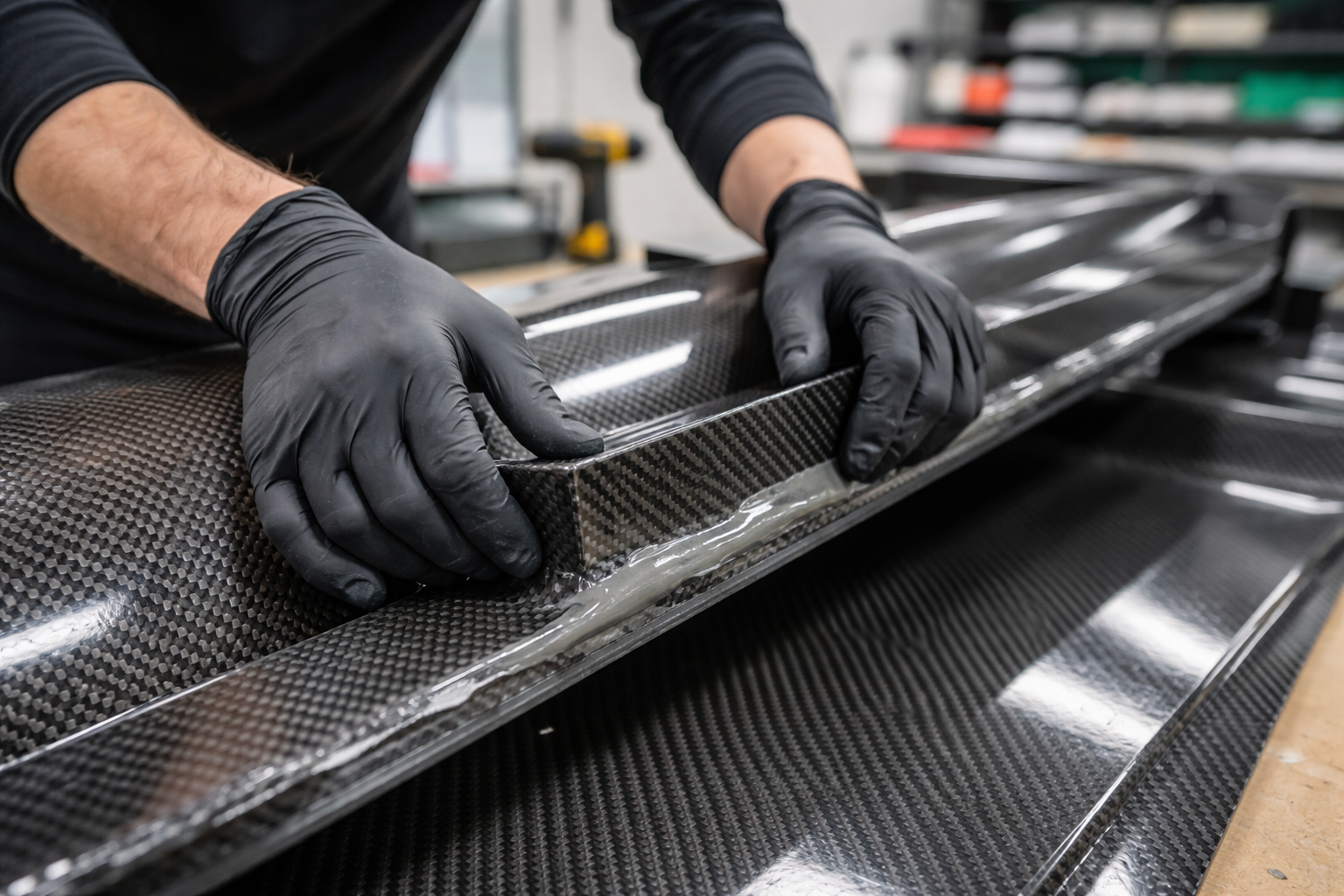
🔧 Quick Answer – Best Adhesive for Carbon Fibre
- Best overall: Permabond ET5428 (structural epoxy for composites)
- Best for speed: Plexus MA300
- Best for larger assemblies: Plexus MA310
- Best for bonding to plastics: Permabond TA4611
- Best for a black bond line: Permabond TA4208
👉 If you need maximum strength and durability, the best adhesive for carbon fibre is typically a structural epoxy like ET5428.
What Makes Carbon Fibre Difficult to Bond?
Carbon fibre reinforced polymer (CFRP) is a composite material with extremely high strength, but it presents several bonding challenges:
- Cannot be welded
- Drilling can weaken structural integrity
- Smooth surfaces reduce adhesion
- Often bonded to dissimilar materials
Because of this, selecting the best adhesive for carbon fibre is critical to achieving long-term performance.
Surface Preparation for Carbon Fibre Bonding
Surface preparation is essential for reliable bonding:
- Degrease using isopropanol or acetone
- Lightly abrade using 320 grit paper or Scotchbrite
- Clean again to remove dust and residue
Even high-performance adhesives can fail without proper preparation.
👉 For more technical guidance on composite bonding, see Permabond’s overview of carbon fibre bonding:
https://permabond.com/blog/how-to-bond-carbon-fiber/
Best Adhesives for Carbon Fibre (Explained)
🥇 1. Structural Epoxy – Best Overall Performance
Structural epoxies are widely considered the best adhesive for carbon fibre when strength and durability are the priority.
Recommended: Permabond ET5428
- Excellent bonding to carbon fibre and composites
- High shear and peel strength
- Resistant to impact, vibration and temperature
- Gap filling up to 5mm
👉 Ideal for: structural bonding, automotive, marine and engineering applications
2. MMA Adhesives – Best for Speed & Production
Methacrylate (MMA) adhesives offer high strength with faster curing and easier handling. For faster structural bonding, see our Plexus MA300 vs MA310 comparison guide.
Recommended:
- Plexus MA300 (fast curing)
- Plexus MA310 (longer working time)
- High strength structural bonding
- Bonds composites, metals and plastics
- More forgiving surface prep
👉 Ideal for: production environments, fabrication and mixed material bonding. MMA adhesives are also perfect for metal to metal applications, for more information you can read our guide strongest glue for metal.
3. Acrylic Adhesives – Best for Carbon Fibre to Plastics
When bonding carbon fibre to low surface energy plastics (PE, PP), specialist adhesives are required. For more information about bonding plastics to different substrates read our blog strongest glue for plastic.
Recommended: Permabond TA4611 or Permabond TA4610
- Bonds difficult plastics without primer
- Good strength and durability
- Suitable for mixed material assemblies
👉 Ideal for: carbon fibre bonded to plastic housings or components
For more difficult plastics or uneven surfaces, Permabond TA4610 may be a better solution due to its gap-filling properties whereas Permabond TA4611 is more suited for tighter fitted joints which provides a cleaner bond line.
For a broader comparison of adhesive types, see our epoxy vs MMA vs polyurethane adhesive guide.
4. Cyanoacrylate (Super Glue) – Small Jobs Only
Cyanoacrylates can bond carbon fibre, but are only suitable for:
- Small parts
- Quick fixes
- Non-structural applications
👉 Not suitable for load-bearing or high-stress environments
4. Best for a black bond line
Permabond TA4208 Black is a two-part, toughened structural acrylic adhesive suited to carbon fibre-to-carbon fibre and carbon fibre-to-metal assemblies. Its black finish blends with dark composite components, while its high shear and peel strength and good impact resistance make it useful for demanding joints. It also bonds aluminium and steel, making it a practical option for mixed-material fabrication.
TA4208 Black has a 4–9 minute pot life and reaches handling strength in approximately 10–15 minutes at 23°C. Its thick consistency allows gap filling up to 3mm. For larger assemblies that need more positioning time, compare it with MA310 before selecting an adhesive.
Best forAdhesive Comparison Chart
| Adhesive Type | Strength | Working Time | Best For | Limitations |
|---|---|---|---|---|
| Epoxy (ET5428) | ⭐⭐⭐⭐⭐ | Medium | Carbon fibre & composites | Slower cure |
| MMA (MA300) | ⭐⭐⭐⭐⭐ | Short | Fast production | Less working time |
| MMA (MA310) | ⭐⭐⭐⭐⭐ | Long | Large assemblies | Slightly slower |
| Acrylic (TA4611) | ⭐⭐⭐⭐ | Medium | Plastic bonding | Not for high-temp |
| Cyanoacrylate | ⭐⭐⭐ | Very fast | Small repairs | Brittle |
| Acrylic (TA4208 Black) | ⭐⭐⭐⭐⭐ | Short | Black carbon fibre and metal joints | Limited positioning time |
Epoxy vs MMA – Which Is Better?
When choosing the best adhesive for carbon fibre, this is the key comparison:
Epoxy (ET5428)
- Higher temperature resistance
- Better long-term durability
- Ideal for composites
MMA (Plexus)
- Faster curing
- More flexible
- Easier to use
👉 Rule of thumb:
- Structural + composites → Epoxy
- Speed + mixed materials → MMA
❌ Common Carbon Fibre Bonding Mistakes
- Skipping surface preparation
- Using general-purpose adhesives
- Choosing fast adhesives over strong ones
- Not considering temperature or environment
Avoiding these mistakes is just as important as selecting the best adhesive for carbon fibre.
Final Thoughts
There is no single “one-size-fits-all” solution, but for most structural applications, the best adhesive for carbon fibre will be a high-performance epoxy such as Permabond ET5428.
For faster applications or mixed material bonding, MMA adhesives like Plexus MA300 or MA310 offer excellent alternatives. These are also top choices for bonding composite panels.
By understanding your application and selecting the correct adhesive system, you can achieve strong, reliable bonds that outperform mechanical fixing methods. For more adhesive advice and technical guides, visit our technical hub.