

Choosing the right structural adhesive can be confusing, especially when deciding between epoxy, MMA (methacrylate), and polyurethane. Each type has different strengths, cure speeds, flexibility, and surface compatibility, so selecting the wrong one can lead to weak bonds or premature failure.
In this guide we compare epoxy vs MMA vs PU adhesive, explain when to use each, and help you choose the best option for metal, plastic, rubber, and composite bonding. If your project involves bonding plastic to metal, our strongest glue for metal to plastic guide covers the most effective solutions. For other substrates to plastic you can read our guide strongest glue for plastics.
If you are unsure which adhesive is best for your job, this comparison will give you a clear starting point.
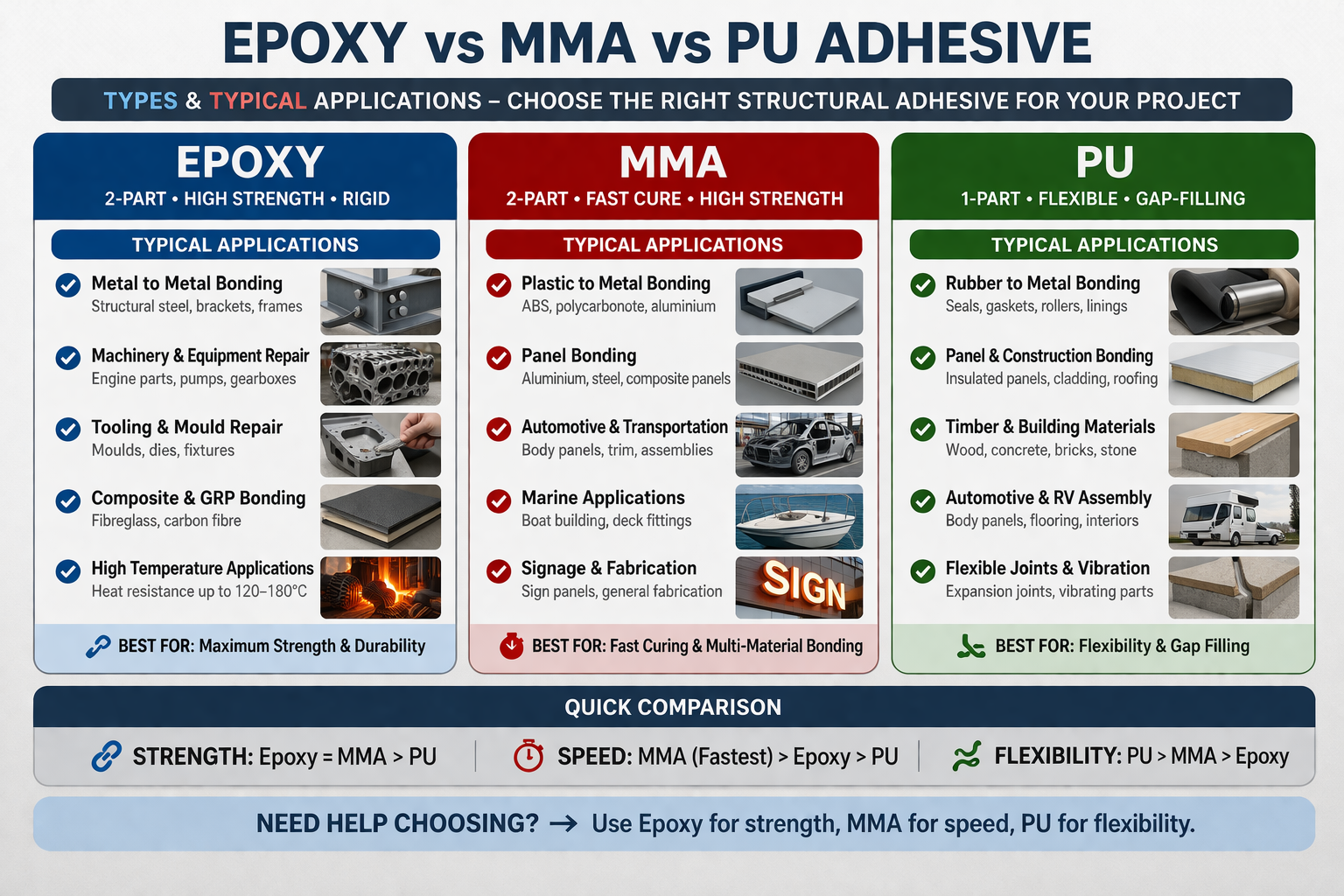
Epoxy vs MMA vs PU adhesive comparison showing strength, flexibility and typical applications.
What Is an Epoxy Adhesive?
Epoxy adhesives are two-part structural adhesives known for very high strength, chemical resistance, and durability. They cure by mixing resin and hardener, creating a rigid bond that performs well in demanding environments.
We stock Permabond ET500 epoxy adhesive, which is a fast-curing structural epoxy suitable for bonding metals, plastics, composites, and engineering materials.
👉 Buy here:
Permabond ET500 Epoxy Adhesive
https://www.adsupply.co.uk/product/permabond-et500-epoxy-adhesive/
Advantages of epoxy
- Very high strength
- Excellent heat resistance
- Strong metal bonding
- Good chemical resistance
- Rigid structural bond
Disadvantages
Epoxy is often the best choice where maximum strength is required, such as metal bonding, engineering parts, or structural assemblies.
Typical Applications for Epoxy Adhesives
Epoxy adhesives are used where maximum strength, chemical resistance, and durability are required. They are commonly used in engineering, manufacturing, and metal fabrication.
Typical uses include:
- Metal to metal bonding
- Structural engineering components
- Machinery and equipment repair
- Bonding brackets and inserts
- Composite and GRP bonding
- High temperature applications
- Tooling and mould repair
Epoxy adhesives are widely used in engineering and manufacturing due to their high strength and chemical resistance. According to the Wikipedia guide to epoxy, these adhesives form strong thermosetting polymers that provide excellent durability in structural applications.
https://en.wikipedia.org/wiki/Epoxy
You may also want to read:
Best Adhesive for Metal to Plastic
What Is an MMA Adhesive?
MMA (methacrylate) adhesives are two-part structural adhesives designed for high strength bonding with faster cure times than epoxy. They are widely used in fabrication, automotive, marine, and composite panel bonding.
Popular examples include Plexus structural adhesives and Permabond acrylic adhesives.
👉 Browse Plexus structural MMA adhesives
👉 Browse Permabond structural MMA adhesives
Typical products include:
Advantages of MMA
- High strength
- Fast cure
- Bonds difficult plastics – TA4611 is top choice for PP and PE low surface energy plastic
- Excellent for metal bonding
- Handles vibration well
Disadvantages
- Strong smell during curing
- Short working time
- Usually more expensive than PU
When comparing epoxy vs MMA vs PU adhesive, MMA is often chosen where fast cure and high strength are needed together.
Typical Applications for MMA Adhesives
MMA (methacrylate) adhesives are widely used where high strength and fast cure are needed, especially when bonding different materials together.
Typical uses include:
- Aluminium and steel bonding
- Plastic to metal bonding
- GRP and composite panels
- Vehicle body panels
- Marine fabrication
- Sign and panel manufacture
- Structural plastic bonding
Products such as Plexus MA310 and Permabond TA4204 are commonly used for these applications because they bond difficult materials quickly and reliably. If you’re bonding carbon fibres read our guide Best Adhesive for Carbon Fibre (UK Guide) – What Actually Works?
You may also find useful:
Structural Adhesive Selection Guide
What Is a PU Adhesive?
Polyurethane (PU) adhesives are flexible structural adhesives used where movement, vibration, or thermal expansion must be absorbed. They are commonly used in construction, vehicle assembly, panels, and rubber bonding.
We supply Adflex PU adhesive, which is suitable for bonding metals, plastics, timber, rubber, and composites.
Advantages of PU
- Flexible bond
- Good gap filling
- Works on many materials
- Good weather resistance
- Easy to use
Disadvantages
- Lower strength than epoxy
- Slower cure than MMA
- Not ideal for high temperature
In an epoxy vs MMA vs PU adhesive comparison, PU is usually chosen where flexibility is more important than maximum strength.
Typical Applications for PU Adhesives
Polyurethane adhesives are used where flexibility, shock resistance, or movement is expected. They are commonly used in construction, automotive, and panel bonding.
Typical uses include:
- Panel bonding
- Timber and construction bonding
- Bonding rubber to metal
- Bonding plastics and composites
- Caravan and vehicle assembly
- Expansion joints and flexible joints
- Outdoor and weatherproof bonding
Adflex PU adhesive is a good example of a flexible structural adhesive suitable for bonding a wide range of materials. Not sure whether epoxy, MMA or PU is best for your panel project? Read our guide to the best adhesive for bonding composite pane
Epoxy vs MMA vs PU Adhesive – Comparison Chart
| Property | Epoxy | MMA | PU |
|---|---|---|---|
| Strength | Very high | Very high | Medium |
| Flexibility | Low | Medium | High |
| Cure speed | Medium | Fast | Medium |
| Gap filling | Good | Good | Excellent |
| Heat resistance | High | Medium | Medium |
| Bonds metal | Excellent | Excellent | Good |
| Bonds plastic | Good | Excellent | Good |
| Bonds rubber | Good | Good | Excellent |
| Best use | Structural metal bonding | Fast structural bonding | Flexible bonding |
This chart shows why choosing between epoxy vs MMA vs PU adhesive depends on the application, not just strength.
When to Use Epoxy
Use epoxy when you need:
- Maximum strength
- High temperature resistance
- Metal to metal bonding
- Chemical resistance
- Rigid structural joints
Best choice:
Permabond ET500 epoxy adhesive
When to Use MMA
Use MMA when you need:
- High strength with fast cure
- Bonding metal to plastic
- Bonding composites
- Panel bonding
- Difficult materials
Best choices:
Plexus MA310
Permabond TA4204
Permabond TA4611
This is why MMA is often preferred in epoxy vs MMA vs PU adhesive comparisons for fabrication and engineering work.
When to Use PU
Use PU when you need:
- Flexible bond
- Vibration resistance
- Bonding panels
- Rubber bonding
- Outdoor use
Best choice:
Adflex PU adhesive
PU is ideal when flexibility matters more than strength in an epoxy vs MMA vs PU adhesive comparison.
Which Adhesive Should You Choose?
Choosing between epoxy vs MMA vs PU adhesive depends on the job:
- Use epoxy for rigid structural bonding
- Use MMA for fast, high strength bonding
- Use PU for flexible bonding
If you are unsure, contact us and we can recommend the best adhesive for your application.
👉 Browse all adhesives
https://www.adsupply.co.uk/industrial-adhesives/
Other Resources:
Best Adhesive for Metal to Plastic | High Strength Bonding Guide (UK)
Best Adhesive for Plastic to Plastic (UK Guide – Strong & Reliable Bonding)
Best Adhesive for Metal to Metal (UK) | High Strength Bonding vs Welding