
Introducing Bostik 2402 – A High-Performance Two-Part Adhesive
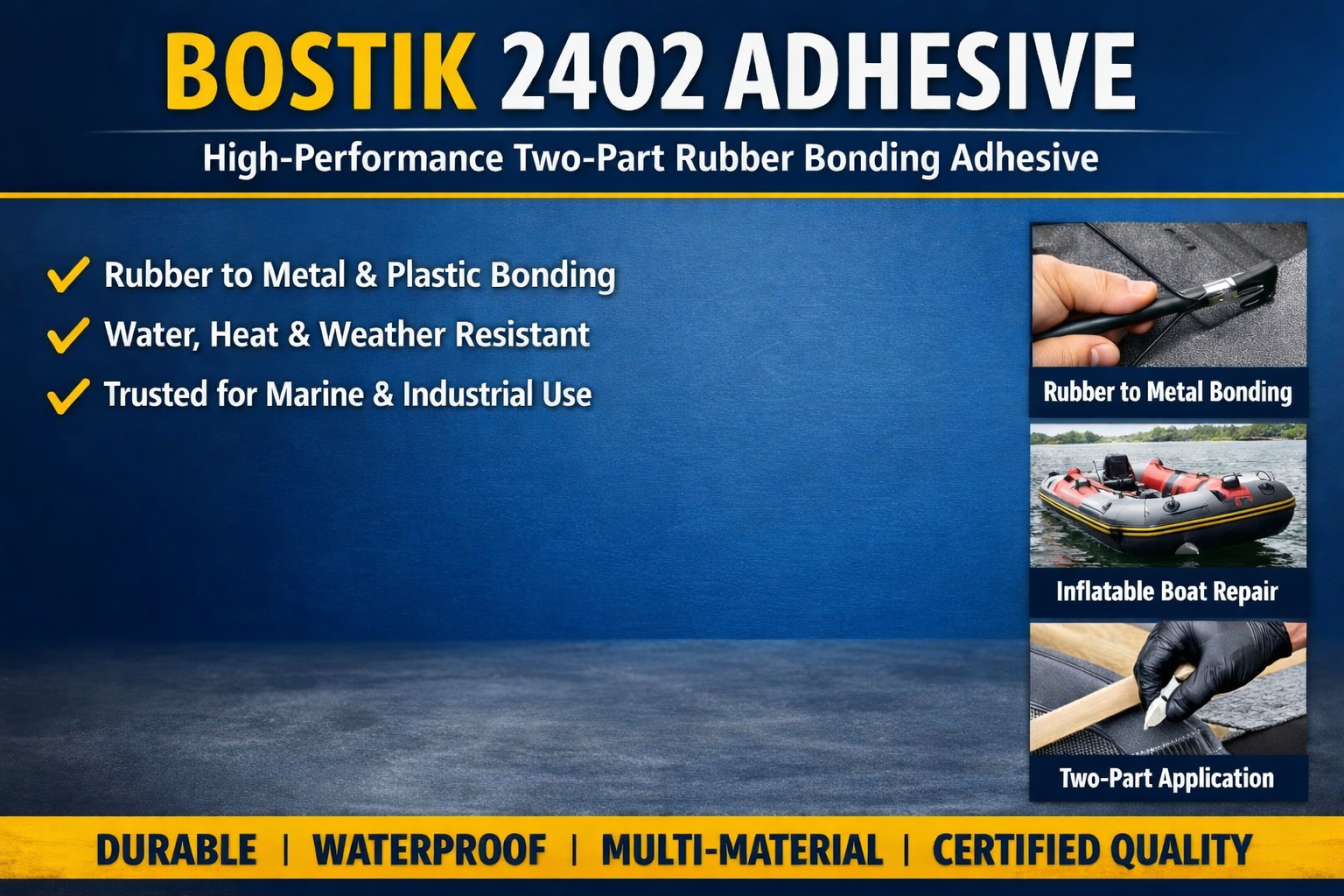
If you need a reliable industrial rubber bonding adhesive, Bostik 2402 is one of the most trusted solutions available in the UK.
This solvent-borne, two-part, cold-curing polychloroprene adhesive is widely used for bonding rubber, metal, wood, rigid plastics and leather where high-strength, flexible and durable bonds are required.
Bostik 2402 is commonly used in:
- Marine repair (including inflatable boats)
- Industrial maintenance
- Rubber fabrication
- Multi-material assemblies
Thanks to its excellent resistance to water, heat, humidity and vibration, it performs where standard contact adhesives often fail.
👉 View available sizes and buy Bostik 2402 here
What is Bostik 2402 adhesive?
Bostik 2402 is a two-part contact adhesive based on polychloroprene rubber. When mixed with the correct curing agent, it produces a high-strength, resilient bond suitable for demanding environments.
It is designed for bonding:
- Natural rubber
- EPDM rubber
- Neoprene
- Nitrile rubber
- Butyl rubber
- Hypalon®
- Polyurethane rubber
- Rigid PVC
- Wood
- Metal
- Leather
If you are unsure which rubber you are working with, see our guides:
Because of its versatility, Bostik 2402 is often chosen when multiple materials need to be bonded with one adhesive. For a wider comparison of adhesive technologies including hybrid polymer, polyurethane and silicone systems, see our full adhesive comparison guide here.
Why use Bostik 2402 adhesive?
Excellent durability in tough environments
Bostik 2402 creates resilient bonds that resist:
-
Water
-
Heat
-
Humidity
-
Vibration
-
Weather exposure
This makes it ideal for marine, industrial and outdoor applications where standard contact adhesives may fail.
Polychloroprene adhesives are widely used in inflatable boat manufacture and repair because they maintain flexibility while providing high strength.
For marine and rubber repair applications, a reliable adhesive is essential to avoid costly failures.
If you’re comparing rubber bonding systems, our guide on the best adhesive for rubber explains when to use contact adhesives vs structural systems.
Bonds Multiple Materials with One System
One of the biggest advantages of Bostik 2402 is its versatility.
Typical uses include:
- Rubber to metal bonding
- Rubber to wood bonding
- Rubber to plastic bonding
- Fabric to rubber
- Foam to metal
👉 For higher-strength structural bonding (especially metals), see our guide on the best adhesive for metal to metal.
If you need an adhesive for EPDM, neoprene or nitrile, see our guide:
👉 Which Adhesive Is Best for Rubber Bonding?
Trusted professional specification adhesive
When used with the correct curing agent, Bostik 2402 meets UK Ministry of Defence specification DTD 900/4679A for certain applications.
This level of approval makes it suitable for:
-
Marine repair
-
Defence and aerospace work
-
Industrial maintenance
-
Specialist manufacturing
Using a specification-approved adhesive gives extra confidence where bond failure is not acceptable.
4. Available in multiple sizes
Bostik 2402 is supplied in:
-
250 ml kit – ideal for small repairs
-
1 litre kit – suitable for regular use
-
5 litre kit – best for production or large jobs
Choosing the correct size helps reduce waste and keeps the adhesive fresh.
👉 Buy Bostik 2402 adhesive here
Real-World Applications of Bostik 2402
Understanding where Bostik 2402 is used in real-world conditions helps highlight why it remains a trusted adhesive across multiple industries.
Marine Repair – Inflatable Boats & RIBs
Bostik 2402 is widely used for repairing inflatable boats, RIB tubes and flotation devices. These applications require a flexible, waterproof bond that can withstand constant movement, pressure and exposure to saltwater.
Its polychloroprene formulation allows it to bond materials such as Hypalon®, neoprene and rubberised fabrics while maintaining long-term elasticity.
Rubber-to-Metal Bonding in Industrial Equipment
In industrial settings, Bostik 2402 is commonly used to bond rubber linings, pads or strips to metal surfaces.
Typical uses include:
- Anti-vibration rubber pads on machinery
- Protective rubber linings on steel components
- Conveyor system repairs
Unlike rigid adhesives, Bostik 2402 absorbs vibration and movement, reducing the risk of bond failure.
👉 For higher load-bearing or structural metal bonding, see our metal to metal adhesive guide.
Rubber Fabrication & Gasket Production
Manufacturers use Bostik 2402 to assemble rubber components where flexibility is essential.
Examples include:
- Gaskets and seals
- Rubber sheeting assemblies
- Foam-to-metal bonding
Its ability to bond multiple materials makes it ideal for multi-material assemblies.
👉 If you’re working with different rubber types, our Rubber Sheet Buying Guide explains key material differences.
Construction & Site Applications
On-site, Bostik 2402 is used for bonding rubber to wood, metal or rigid plastics where durability is required.
Typical uses include:
- Expansion joint materials
- Rubber sealing strips
- Protective edge bonding
Its resistance to moisture and temperature variation makes it suitable for outdoor and exposed environments.
👉 For flexible sealing systems, see our hybrid polymer vs polyurethane vs silicone adhesive guide.
How to Use Bostik 2402
Here is a step-by-step guide to achieve the best results:
A. Surface preparation
-
Ensure surfaces are dry, clean and grease-free. On metal or rigid surfaces, wipe with a solvent such as Bostik Cleaner/Thinner M501, abrade with emery cloth, and wipe again.
-
On wood or decorative laminates, abrasion may not always be necessary but cleanliness is essential.
-
Important: Do not use on plasticised PVC (because plasticiser migration can weaken the bond).
B. Mixing the adhesive
-
Stir the adhesive thoroughly to re-disperse any settled ingredients.
-
Mix with the curing agent (for example, Bostikure D) in the correct ratio: typically 100 parts adhesive to 6 parts curing agent (by weight).
-
After mixing, you have a limited “pot life” (time in which the mixed adhesive remains usable) — make sure you apply before it begins to set.
C. Application & bonding
-
Apply an even coat of the mixed adhesive to both mating surfaces (via brush, roller or serrated spreader).
-
Allow the adhesive to flash off (dry) for about 5–15 minutes (or 10–20 minutes depending on ambient conditions) until you can touch with the knuckles without transfer. Two thinner coats are preferable rather than a single heavy coat.
-
Bring the surfaces together, avoid trapping air, and apply as much pressure as possible to ensure intimate contact.
-
Handling strength may be achieved in minutes, but full cure may take days — if necessary you can accelerate curing by applying heat (e.g., +70 °C for 2 h) if the manufacturer’s TDS allows.
D. Post-application & cleanup
-
Clean up any excess adhesive with recommended thinner/solvent (e.g., M501).
-
Store any unused adhesive in cool, dry conditions, tightly closed. Solvent vapours are flammable.
-
Always consult the Safety Data Sheet (SDS) for hazard instructions — for example, Bostik 2402 is classified as highly flammable, causes skin/eye irritation and may affect unborn child; fresh vapours may be harmful.
Benefits at a Glance
-
Versatile substrate bonding: One adhesive handles rubbers, rigid plastics, wood, metal and leather.
-
High resilience: Bonds resist water, heat and humidity — excellent for challenging environments like marine, industrial or outdoors.
-
Professional-grade performance: Two-part cold curing system, certified for demanding applications (e.g., MOD spec). Bostik 1782 vs 2402
-
Size flexibility: Choose 250 ml, 1 L or 5 L depending on job size — reduces wastage.
-
Reliable bond integrity: With correct preparation and application, you get durability, fewer failures and long service life.
-
Confidence from expertise: Backed by manufacturer guidance and widely used in sectors such as inflatable boat manufacture and repair.
Bostik 2402 vs Other Adhesive Types
Compared with standard contact adhesives, Bostik 2402 offers:
-
Higher bond strength
-
Better water resistance
-
Better heat resistance
-
Longer service life
-
Greater flexibility
| Adhesive Type | Strength | Flexibility | Best For | Limitations |
|---|---|---|---|---|
| Bostik 2402 (Polychloroprene) | ⭐⭐⭐⭐ High | ⭐⭐⭐⭐ High | Rubber bonding, marine repair, flexible joints | Requires mixing, solvent-based |
| Standard Contact Adhesive | ⭐⭐⭐ Medium | ⭐⭐⭐ Medium | Light-duty bonding | Lower durability, weaker resistance |
| MMA (e.g. Plexus) | ⭐⭐⭐⭐⭐ Very High | ⭐⭐⭐ Medium | Structural bonding, metal assemblies | Less flexible for rubber |
| Epoxy (e.g. Araldite / ET500) | ⭐⭐⭐⭐ High | ⭐⭐ Low | Rigid, high-strength bonds | Brittle under movement |
| Hybrid Polymer (e.g. HB42) | ⭐⭐⭐ Medium | ⭐⭐⭐⭐⭐ Very High | Sealing + bonding | Not structural |
| Cyanoacrylate (Super Glue) | ⭐⭐⭐ Medium | ⭐ Low | Small, fast bonds | Poor gap filling, brittle |
For a detailed comparison see:
👉 Bostik 1782 vs Bostik 2402 – What’s the difference?
Who Should Use It?
-
Marine repairers of inflatable boats, RIBs or floatation devices needing resilient rubber-to-substrate bonds. If you’re specifically bonding EPDM rubber, see our full EPDM adhesive comparison guide.
-
Industrial maintenance teams bonding rubber or elastomeric components to metal, wood or rigid plastics.
-
Manufacturers working with multi-material assemblies (rubber + metal + wood) who require a strong, proven adhesive. Check out more information here for metal to metal or rubber to metal applications
-
Anyone replacing multiple adhesive types with one versatile system to simplify inventory and training.
Final Thoughts
If you’re working with challenging substrates, need a high-performance bond and want to reduce the risk of failure in demanding conditions, Bostik 2402 is a strong contender. Ensure you follow surface preparation and mixing instructions carefully and invest in proper ventilation and safety due to the solvent-borne nature. If you need a moisture-curing polyurethane adhesive instead of a solvent contact adhesive, see our Arbothane 1245 adhesive guide.
Ready to buy? Get Bostik 2402 here
Further reading: For more on how adhesives for inflatable boats and rubber bonding work see this excellent resource from Polymarine: Inflatable boat repair glue – Polymarine Polymarine