Bostik 1782 vs 2402: What’s the Difference?
Choosing between Bostik 1782 vs Bostik 2402 comes down to one key question:
Do you need a general-purpose adhesive — or a high-performance rubber bonding system?
Both are polychloroprene contact adhesives, but they are designed for very different environments. Choosing the wrong one can lead to premature bond failure, especially in marine or industrial applications.
In this guide, we break down the differences between Bostik 1782 and 2402, including strength, flexibility, durability, and when to use each.
For more discussion on rubber bonding adhesives in the marine industry (including strong preference for products such as 2402), see this forum thread: RIBnet – “Always use the Bostik 2 part, either 2402…” rib.net
Bostik 1782 vs 2402 – Quick Answer
- Use Bostik 1782 for general-purpose bonding, upholstery, and decorative work
- Use Bostik 2402 for rubber bonding, marine repair, and demanding environments
What is Bostik 1782?
Bostik 1782 is a general-purpose polychloroprene contact adhesive with medium viscosity that dries clear and non-staining.
It is commonly used for bonding:
-
Leather
-
Wood
-
Metal
-
Canvas
-
Rigid plastics
-
Rubber (light duty)
When used with Bostikure D curing agent, Bostik 1782 becomes a two-part system with improved resistance to:
-
Heat
-
Oil
-
Petrol
-
Kerosene
-
Ageing
Because it dries clear, Bostik 1782 is often chosen for visible or decorative work.
👉 View Bostik 1782 adhesive here
What is Bostik 2402?
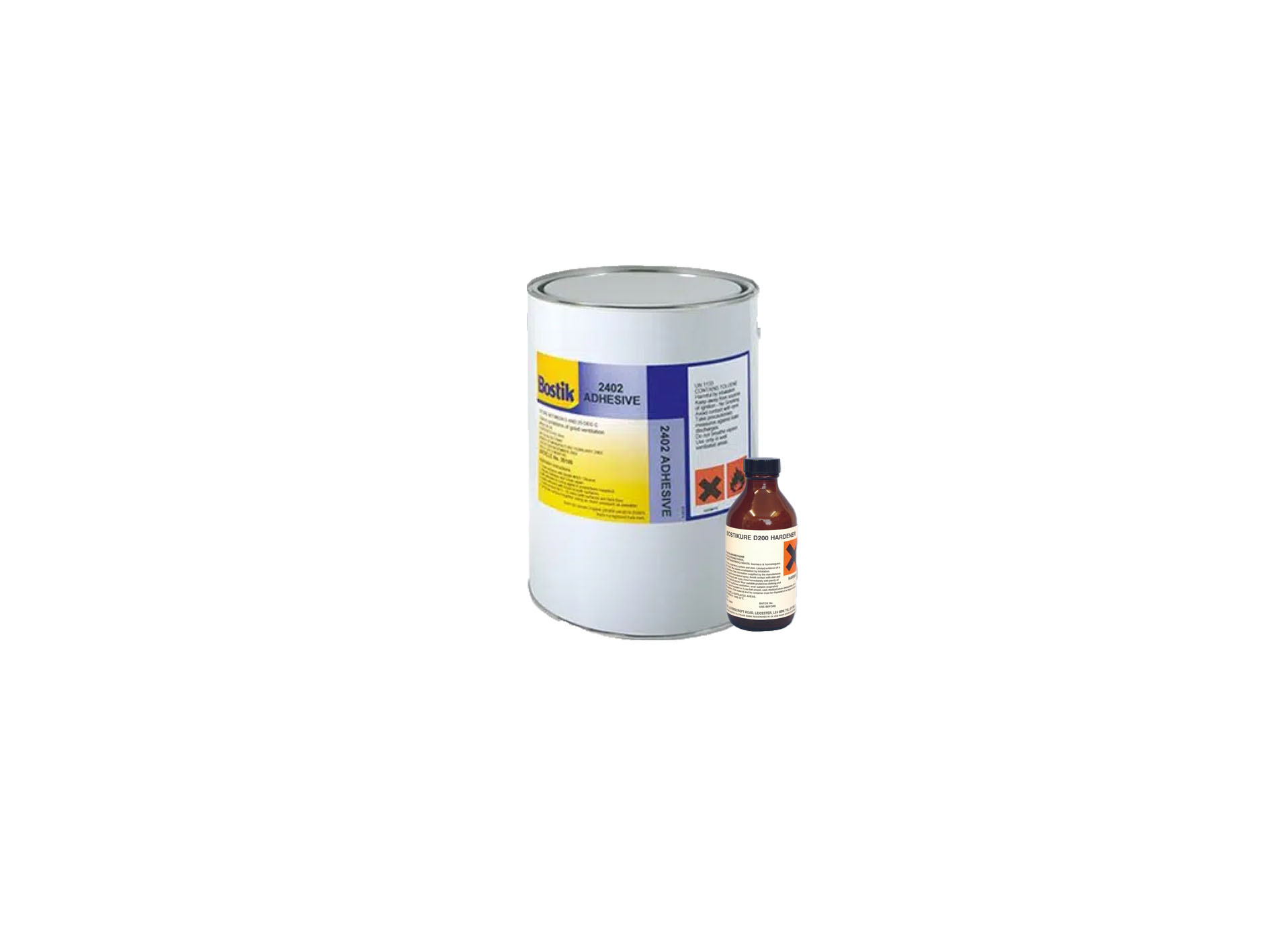
Bostik 2402 is a high-performance two-part polychloroprene adhesive designed for demanding rubber bonding applications.
It is widely used for bonding:
-
Natural rubber
-
Neoprene
-
Nitrile rubber
-
Butyl rubber
-
Hypalon®
-
Polyurethane rubber
-
Metal
-
Wood
-
Rigid PVC
-
Leather
When mixed with the correct curing agent, Bostik 2402 produces a strong, flexible and water-resistant bond, making it suitable for marine, automotive and industrial use.
👉 View Bostik 2402 adhesive here
For a full guide, see our article:
👉 Bostik 2402 adhesive – uses and benefits
If you’re unsure which adhesive technology is best for your application, see our guide comparing hybrid polymer, PU and silicone adhesives to understand the differences in flexibility, strength and weather resistance.
Key Differences:
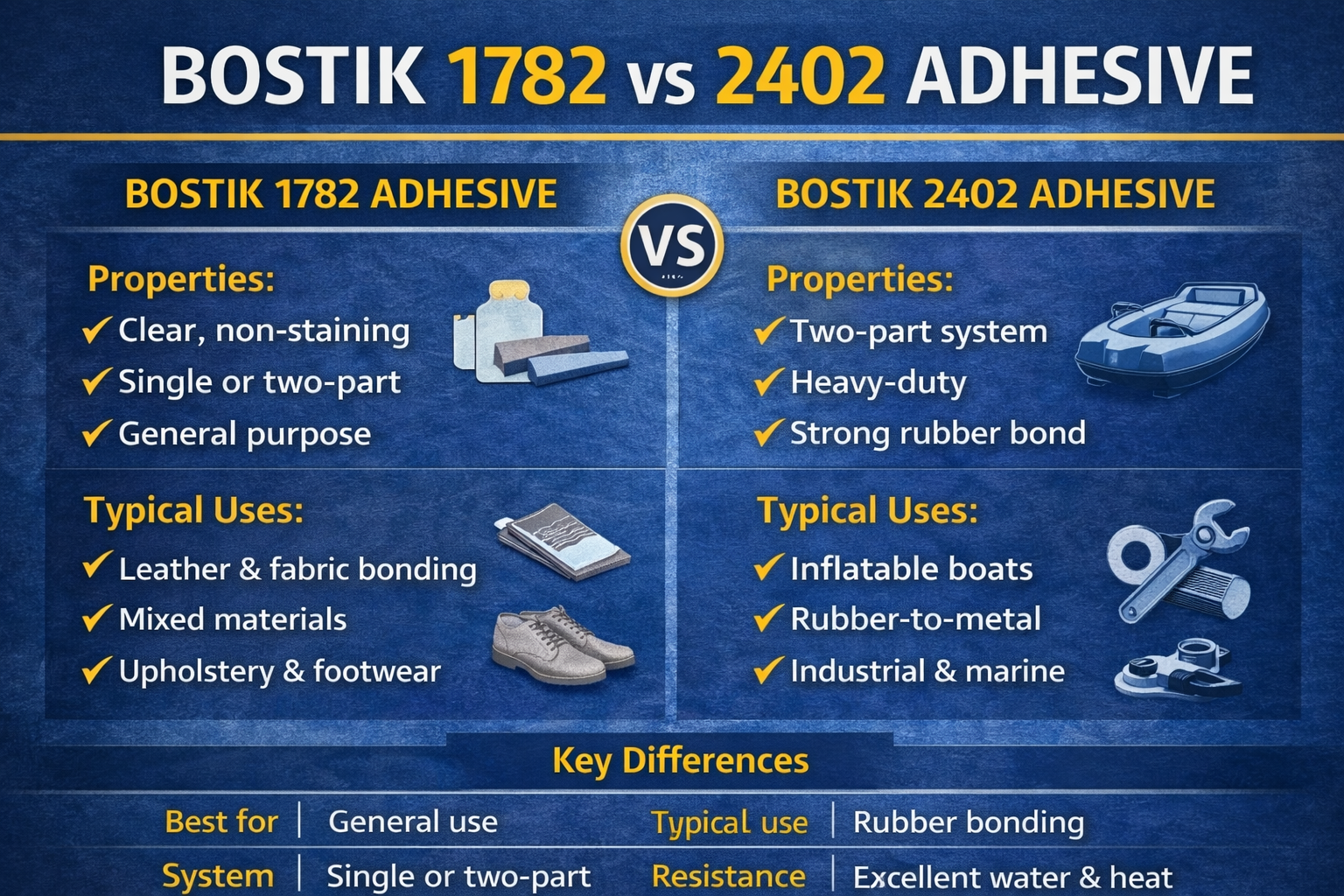
1. Primary Materials & Substrates
Bostik 1782 vs 2402
-
1782 is aimed at more general materials — leather, wood, canvas, plastics and metals.
-
2402 is more specialised for rubber surfaces (including Hypalon®), rigid plastics and metals with resilient bonding demands.
2. Bonding Environment & Resilience
Bostik 1782 vs 2402
-
2402 emphasises strong resilience: “good resistance to water, heat, humidity” and is used in demanding conditions (eg. marine inflatable products).
-
1782 provides good chemical and temperature resistance and ageing properties but is pitched as a general-purpose adhesive.
3. System Type & Application
Bostik 1782 vs 2402
-
1782: Can be used as a single-part adhesive or upgraded to a two-part system with curing agent for enhanced performance.
-
2402: Explicitly a two-part, cold-curing adhesive system (needs Bostikure D or equivalent hardener) for full performance.
4. Typical Application Use-cases
Bostik 1782 vs 2402
-
1782: Good for upholstery, furniture, footwear, leather goods, general workshop bonding tasks, and where aesthetics (clear, non-staining) matter.
-
2402: Excellent for rubber-to-rigid bonding, inflatable boats, marine repair, industrial rubber lining, and other heavy-duty bonding under adverse conditions.
| Feature | Bostik 1782 | Bostik 2402 |
|---|---|---|
| Type | General purpose contact adhesive | High-performance rubber adhesive |
| System | Single or two-part | Two-part system |
| Strength | Medium–High | High |
| Flexibility | Medium | High |
| Water resistance | Good | Excellent |
| Heat resistance | Good | Very good |
| Best for | Leather, wood, upholstery | Rubber, marine, industrial |
| Finish | Clear | Amber |
| Difficulty | Easy | Moderate (requires mixing) |
| Typical use | Workshop, furniture | Inflatable boats, rubber lining |
Both adhesives are based on polychloroprene, but 2402 is designed for heavy-duty rubber bonding, while 1782 is more versatile for general use.
Choose Bostik 1782 when:
-
You need a clear, non-staining adhesive
-
Bonding leather, wood or fabric
-
General workshop repairs
-
Upholstery work
-
Furniture or footwear manufacture
-
Light rubber bonding
Because it can be used as a single-part adhesive, it is often easier to use for small jobs.
When should you use Bostik 2402?
Choose Bostik 2402 when:
-
Bonding rubber to metal or plastic
-
Repairing inflatable boats or RIB tubes
-
Working in marine environments
-
Industrial rubber lining
-
Bonding neoprene, nitrile or Hypalon®
-
Applications exposed to water, heat or vibration
Bostik 2402 is widely used in marine and industrial sectors because of its strong, resilient bond and high durability. If bonding rubber to metal or plastics, our strongest glue for metal to plastic guide explains alternative systems.
For more details see:
👉 Best adhesive for rubber bonding
When NOT to Use Each Adhesive
Avoid Bostik 1782 when:
- Bonding rubber in demanding environments
- Exposure to water, fuel or vibration
- Marine applications
Avoid Bostik 2402 when:
- You need a clear, invisible finish
- Working on small decorative jobs
- You want a simple, single-part adhesive
Benefits of Each
1782 Benefits:
-
Clear, non-staining finish — ideal for visible/ decorative surfaces.
-
Good all-round adhesion across many substrates.
-
Flexibility to upgrade to two-part for higher demands (with curing agent).
2402 Benefits:
-
High performance for critical rubber-bonding applications.
-
Robust against water, heat, humidity — suited to marine, industrial environments.
-
Two-part ensures stronger, more resilient bonds when properly applied.
Real-World Applications
Upholstery & Workshop Use (1782)
Bostik 1782 is widely used in:
- Furniture manufacturing
- Leatherwork
- Footwear
- General workshop bonding
Its clear finish makes it ideal where appearance matters.
Marine & Inflatable Boat Repair (2402)
Bostik 2402 is the go-to for:
- Inflatable boats (RIBs)
- Hypalon® repairs
- Rubberised fabrics
It provides a flexible, waterproof bond that withstands pressure and movement.
👉 For a deeper dive, see our Bostik 2402 adhesive guide.
Industrial Rubber Bonding (2402)
Used for:
- Rubber-to-metal bonding
- Machinery linings
- Conveyor systems
👉 For structural alternatives, see our metal to metal adhesive guide.
How are Bostik 1782 and 2402 applied?
Both adhesives are applied in a similar way:
-
Clean surfaces thoroughly
-
Abrade smooth materials if required
-
Apply adhesive to both surfaces
-
Allow to flash off
-
Bring surfaces together under pressure
For high-performance bonding, both can be used with curing agent.
Always follow the technical data sheet for correct ratios and working time.
For difficult rubber bonding applications, two-part systems such as Bostik 2402 usually give the best results.
Alternatives to Bostik 1782 and 2402
Depending on the application, other adhesives may be more suitable. For applications where a polyurethane adhesive may be more suitable, see our Arbothane 1245 adhesive guide for high-strength flexible bonding.
For example:
-
Hybrid sealant adhesives such as HB42 are useful where flexibility is needed
-
Structural adhesives may be required for load-bearing joints
See also:
👉 HB42 adhesive guide
👉 Structural adhesive comparison
👉 Rubber bonding guide
This helps you choose the correct adhesive for the job.
Which adhesive lasts longer?
In demanding environments, Bostik 2402 usually lasts longer because:
-
Stronger rubber adhesion
-
Better water resistance
-
Higher heat resistance
-
More flexible bond
Bostik 1782 is durable for general use, but not designed for extreme conditions.
If the joint will be exposed to water, vibration or fuel, 2402 is normally the better choice.
Buy Now Links
-
Buy Bostik 1782: Bostik 1782 Clear Adhesive
-
Buy Bostik 2402: Bostik 2402 Polychloroprene Adhesive
FAQ – Bostik 1782 vs 2402
Is Bostik 2402 stronger than 1782?
Yes, 2402 is designed for heavy-duty rubber bonding and marine applications.
Can Bostik 1782 bond rubber?
Yes, but for demanding rubber bonding 2402 is usually better.
Do both adhesives need hardener?
1782 can be used without hardener, but both perform better with curing agent.
Which adhesive is best for inflatable boats?
Bostik 2402 is commonly used for inflatable boat repair.
Can these adhesives be used outdoors?
Yes, but 2402 offers better long-term weather resistance.
Final Thoughts
Both Bostik adhesives are excellent — but matching the right adhesive to the job is key. If your bonding involves rubber to rigid substrates, under tough conditions (marine, industrial), then 2402 is the specialist tool. For demanding rubber bonding, see our full guide on the best adhesive for rubber.
If your task is more general workshop bonding, clear finish, mixed materials and moderate conditions — 1782 gives a versatile solution with cost-efficiency.
By selecting the right product and following proper surface preparation and application protocols, you’ll maximise performance, reduce re-work and deliver professional results.
👉 Buy Bostik 1782
👉 Buy Bostik 2402
👉 Read our Bostik 2402 guide here
Read our blog guide on bostik 2402 adhesive including how to use, key benefits & why it’s the best rubber bonding glue here