

When it comes to reliable rubber sealing materials, EPDM foam sponge is one of the most widely used options across construction, HVAC, automotive, marine and industrial applications.
Known for its excellent resistance to weather, temperature extremes and compression fatigue, EPDM sponge rubber is ideal for seals, gaskets, vibration pads and enclosure protection where long-term durability is required.
In this guide we explain what EPDM foam sponge is, its key properties, common applications, and how to choose the right EPDM roll or sheet for your project. You can view our full range of EPDM sponge rubber rolls & sheets here.
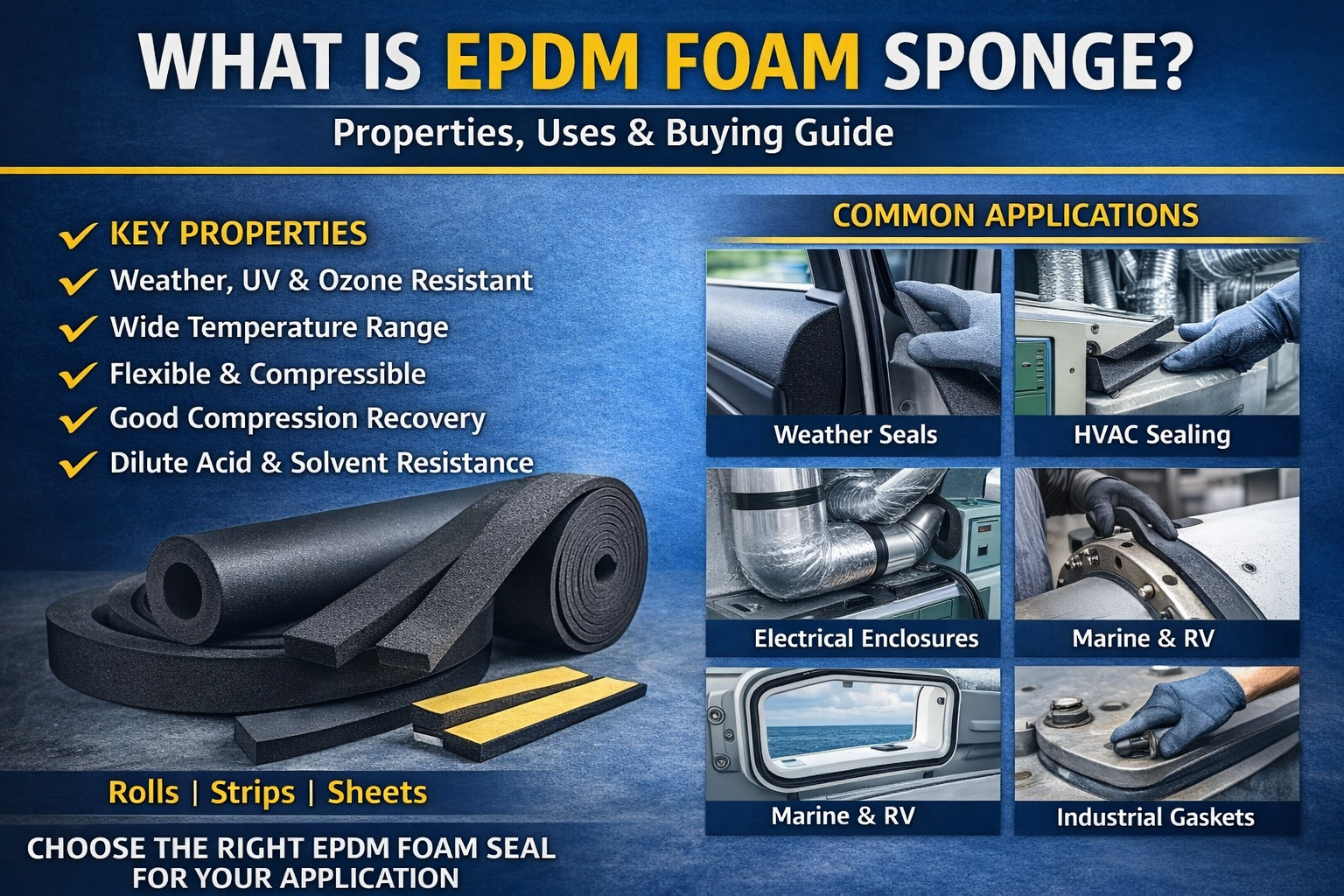
What Is EPDM Foam Sponge?
EPDM stands for Ethylene Propylene Diene Monomer, a synthetic rubber specifically engineered for durability in demanding environments. Unlike solid EPDM rubber, EPDM foam sponge is produced with a cellular structure, making it lightweight, compressible, and ideal for sealing applications where flexibility is essential.
The foam structure allows the material to compress under pressure and return to its original shape once the force is removed. This makes EPDM foam sponge particularly effective for gaskets, weather seals, vibration damping, and enclosure protection.
According to an independent technical overview by Wikipedia, EPDM is especially valued for its resistance to heat, UV, ozone, and weathering, making it one of the most widely used rubbers for outdoor exposure:
https://en.wikipedia.org/wiki/EPDM
Key Performance Properties of EPDM Foam Sponge
When assessing EPDM sponge rubber, the specification is just as important as the material itself. A high-quality EPDM foam sponge with the following properties is suitable for a wide range of professional sealing applications:
-
Density: 120kg/m³
This density provides an ideal balance between mechanical strength and flexibility. -
Temperature Range: -40°C to +100°C
This wide operating range means EPDM performs reliably in freezing outdoor conditions as well as warm industrial environments. -
Shore Hardness: 00 Scale 35 ± 6
This indicates a soft, highly compressible sponge ideal for sealing uneven surfaces. -
Very Good Weather Resistance
Outstanding resistance to UV exposure, rain, frost, and atmospheric pollutants. -
Good Compression Recovery
Maintains sealing force over repeated compression cycles. -
Good Resistance to Solvents
Suitable for light solvent exposure in industrial settings. -
Dilute Acid Resistance
Performs well in mildly corrosive environments.
These properties are the reason EPDM foam sponge is widely specified for critical sealing roles where long-term reliability is required.
Other typical properties of high-quality EPDM sponge rubber include:
• Excellent UV resistance
• Good ozone resistance
• Wide temperature range
• Good compression recovery
• Flexible closed-cell structure
• Suitable for indoor and outdoor sealing
Common Applications of EPDM Foam Sponge
Thanks to its excellent resistance profile and compressibility, EPDM foam sponge is used across many industries:
-
Window & Door Seals – Creates weather-tight closures and improves thermal efficiency.
-
HVAC Systems – Used for duct seals, vibration isolation, and enclosure protection.
-
Automotive Sealing – Door seals, bonnet seals, and noise vibration damping.
-
Electrical Enclosures – Prevents moisture and dust ingress.
-
Marine & Outdoor Equipment – Ideal for harsh coastal and wet environments.
-
Industrial Machinery – Used as gaskets for vibration control and environmental sealing.
Because of its flexibility and durability, EPDM foam sponge remains one of the most versatile sealing materials available. Other applications also include:
-
Window seals
-
Door seals
-
HVAC sealing
-
Electrical enclosures
-
Marine hatches
-
Industrial panels
-
Weather seals
-
Vibration pads
-
Gaskets
-
Compression seals
EPDM Roll vs Sheet vs Gaskets
EPDM is available in several forms, but EPDM roll is often the most practical and cost-effective option for sealing applications. Rolls allow for:
-
Continuous seals without joints
-
Easy cut-to-length installation
-
Reduced wastage
-
Faster fitting on site
Sheets are ideal for custom die-cut gaskets, while pre-formed gaskets suit high-volume repeat applications. However, for installers and maintenance teams, EPDM roll offers maximum flexibility on demand.
You can purchase EPDM sponge rubber in roll form directly here:
https://www.adsupply.co.uk/rubber/epdm-sponge/
This allows you to select the thickness and length required for your specific application.
Why EPDM Foam Outperforms Many Other Rubbers
Compared to other common sponge rubbers such as neoprene or PVC foam, EPDM foam sponge offers several superior advantages:
-
Much better UV and ozone resistance
-
Wider working temperature range
-
Excellent long-term outdoor durability
-
Lower risk of cracking or hardening
-
Better compression recovery over time
However, it’s important to note that EPDM is not recommended for constant contact with oils, fuels, or hydrocarbons, where materials such as nitrile rubber would be more suitable.
EPDM sponge vs neoprene vs nitrile sponge
EPDM sponge rubber is often compared with neoprene and nitrile sponge rubber. Each material has different strengths depending on the environment.
| Material | Weather resistance | Oil resistance | Temperature | Typical use |
|---|---|---|---|---|
| EPDM sponge | Excellent | Poor | Wide | Outdoor seals |
| Neoprene sponge | Good | Moderate | Medium | General sealing |
| Nitrile sponge | Moderate | Excellent | Medium | Oil environments |
EPDM is usually the best choice for outdoor sealing, weatherproofing and construction applications.
How to Choose the Right EPDM Sponge for Your Application
When selecting EPDM foam sponge, consider the following factors:
-
Compression Gap
Match the sponge thickness to the gap you need to seal to ensure correct compression. -
Environmental Exposure
Outdoor, UV, and moisture exposure strongly favour EPDM over many alternatives. -
Temperature Range
Applications exposed to freezing or elevated heat environments benefit from EPDM’s thermal stability. -
Chemical Exposure
Light solvents and dilute acids are acceptable; oils and fuels are not. -
Installation Method
EPDM rolls are ideal for continuous sealing, while sheet material is best for gasket cutting.
Choosing the right specification ensures long service life and consistent sealing performance.
Fixing and bonding EPDM sponge rubber
EPDM sponge can be installed using mechanical fixing, pressure fit, or adhesive bonding depending on the application.
For permanent installation, contact adhesives and sealant adhesives are commonly used.
Examples include:
-
Contact adhesives for rubber bonding
-
Hybrid sealant adhesives for flexible joints
-
Structural adhesives where high strength is required
For more information see:
FAQ – EPDM foam sponge
Is EPDM sponge waterproof?
Yes, EPDM sponge has excellent water resistance and is commonly used for outdoor sealing.
Can EPDM sponge be used outside?
Yes, EPDM has excellent UV and weather resistance.
Can EPDM sponge be glued?
Yes, EPDM can be bonded using contact adhesive or sealant adhesive.
Is EPDM better than neoprene?
For outdoor use, EPDM is usually better due to UV resistance.
What density EPDM sponge should I use?
Medium density (around 120kg/m³) suits most sealing applications.
Summary
EPDM foam sponge is one of the most versatile rubber sealing materials available, offering excellent weather resistance, flexibility and long service life.
It is widely used for window seals, HVAC sealing, marine equipment, electrical enclosures and industrial gaskets where reliable compression sealing is required.
Choosing the correct thickness, density and format — roll, strip or sheet — will ensure the best performance for your application.
View our full range of EPDM sponge rubber rolls and sheets to find the right specification.