
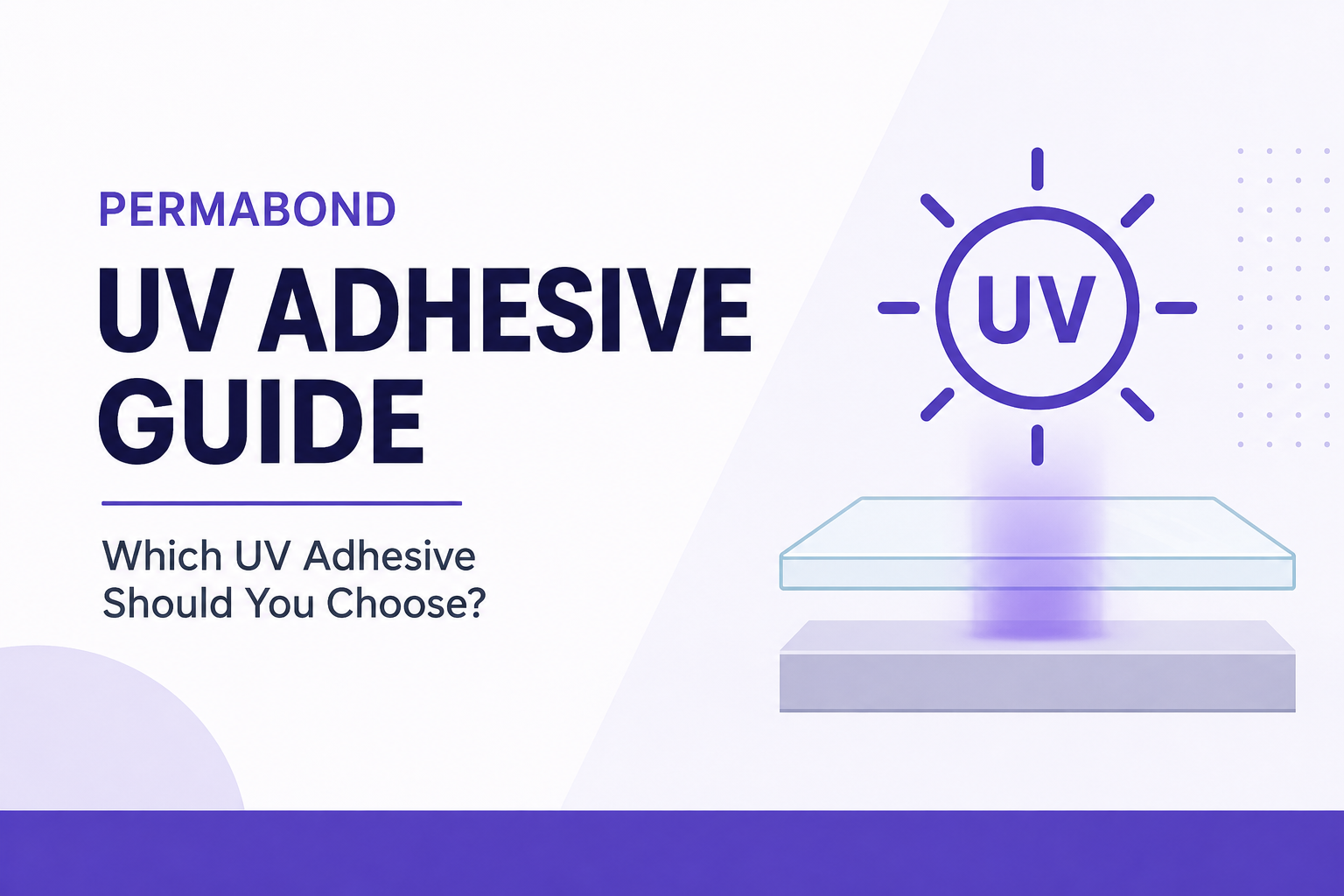
Selecting the right Permabond UV adhesive is essential for achieving a strong, reliable bond. While UV-curing adhesives all share the advantage of rapid curing under ultraviolet light, each product has been formulated for different substrates and applications.
Whether you’re bonding glass furniture, crystal displays, architectural glazing or engineering plastics, choosing the correct adhesive will improve bond strength, appearance and long-term durability.
In this guide, we’ll compare the Permabond UV adhesive range, explain when each product should be used, and help you decide which adhesive is best suited to your application.
What is a Permabond UV adhesive?
A Permabond UV adhesive is a single-component light-curing adhesive that remains liquid until exposed to ultraviolet (UV) light. Unlike two-part epoxies or structural acrylics, there is no mixing required, allowing unlimited positioning time before curing.
Once exposed to a suitable UV lamp, the adhesive cures in seconds, making it ideal for manufacturing, assembly and production environments where speed and appearance are equally important.
Benefits of UV-curing adhesives
- Single-component formulation
- Cure on demand using UV light
- Extremely fast fixture times
- Excellent optical clarity
- High bond strength
- Clean, solvent-free application
- Minimal shrinkage during cure
- Ideal for visible bond lines
When should you use a UV adhesive?
UV adhesives are best suited to applications where at least one substrate allows UV light to pass through to the adhesive.
Typical applications include:
- Glass furniture
- Crystal displays
- Display cabinets
- Glass shelving
- Architectural glazing
- Acrylic displays
- Polycarbonate components
- PETG assemblies
- Medical devices
- Electronic housings
- Decorative glass products
When shouldn’t you use a UV adhesive?
Although UV adhesives are extremely versatile, they are not suitable for every bonding application.
A UV adhesive may not be the best choice when:
- Both substrates are opaque and UV light cannot reach the adhesive.
- Large bond gaps need to be filled.
- Bonding polypropylene (PP) or polyethylene (PE), which generally require specialist structural acrylic adhesives.
- Very large structural joints requiring high impact resistance are involved, where products such as MMA or epoxy adhesives may be more appropriate.
For difficult plastics, you may also find our guides on the Best Adhesive for Bonding Fibreglass to Plastic useful, as they explain when structural acrylic adhesives may be a better alternative depending on the substrates involved.
Permabond UV Adhesive Comparison
| Product | Best For | Main Materials | Key Benefit |
|---|---|---|---|
| UV605 | General glass bonding | Glass, crystal, metal | Low viscosity, invisible bond lines |
| UV610 | Glass to metal | Glass, metal | Medium viscosity with improved gap filling |
| UV620 | Glass furniture & decorative glazing | Glass, crystal, metal | High optical clarity & yellowing resistance |
| UV6260 | Engineering plastics | Polycarbonate, PETG, ABS, PVC, coloured glass | Extremely fast cure & tack-free finish |
| UV6357 | Flexible applications | Glass, metal | Low temperature performance & flexibility |
Permabond UV605
Best for:
- Glass to glass
- Glass to metal
- Crystal
- Decorative glass assemblies
Permabond UV605 is the general-purpose glass adhesive within the range. Its low viscosity allows it to flow into tight bond lines, creating almost invisible joints with excellent strength.
Use UV605 when:
✔ Bonding crystal
✔ Glass display cabinets
✔ Glass shelves
✔ Glass furniture
Avoid UV605 when:
✖ Bonding engineering plastics
✖ Greater flexibility is required
Permabond UV610
Best for:
- Glass to metal
- Medium bond gaps
- Decorative glazing
UV610 offers similar performance to UV605 but with a higher viscosity, making it better suited where a slightly thicker adhesive layer is beneficial.
Use UV610 when:
✔ Bonding metal brackets to glass
✔ Display furniture
✔ Decorative glazing
Avoid UV610 when:
✖ High optical clarity is the primary requirement
✖ Bonding engineering plastics
Permabond UV620
Best for:
- Glass furniture
- Crystal
- Architectural glazing
- Decorative glass
UV620 has been developed for applications where appearance is just as important as bond strength.
Its optically clear formulation resists yellowing while its high elongation allows movement between bonded glass and metal caused by temperature changes.
Use UV620 when:
✔ Glass furniture
✔ Decorative glazing
✔ Architectural glass
✔ Crystal displays
Avoid UV620 when:
✖ Bonding opaque substrates
✖ UV light cannot reach the adhesive
Permabond UV6260
Best for:
- Engineering plastics
- Coloured glass
- Fritted glass
- Mixed material assemblies
UV6260 is one of the most versatile products within the range.
Unlike many UV adhesives developed primarily for glass, UV6260 has been engineered to bond a wide variety of engineering plastics including:
- Polycarbonate
- Acrylic (PMMA)
- PETG
- PET
- ABS
- Rigid PVC
It also performs exceptionally well on coloured and fritted glass where standard UV adhesives can struggle.
Use UV6260 when:
✔ Bonding engineering plastics
✔ Acrylic display products
✔ Polycarbonate assemblies
✔ Coloured glass
✔ Fritted glass
Avoid UV6260 when:
✖ Bonding polypropylene or polyethylene
✖ UV light cannot penetrate the joint
Permabond UV6357
Best for:
- Low temperature environments
- Flexible joints
- Thermal movement
UV6357 is designed for applications where greater flexibility is required.
Its formulation allows bonded joints to better absorb vibration and thermal expansion, making it suitable where more rigid UV adhesives may become stressed.
Use UV6357 when:
✔ Low temperature applications
✔ Flexible joints
✔ Glass bonded to metal
✔ Assemblies exposed to thermal cycling
Avoid UV6357 when:
✖ Maximum optical clarity is the priority
✖ Bonding opaque materials
Which UV adhesive should you choose?
If you’re unsure which Permabond UV adhesive is right for your application, the following guide provides a useful starting point.
| Application | Recommended Product |
|---|---|
| General glass bonding | UV605 |
| Glass to metal | UV610 |
| Glass furniture | UV620 |
| Crystal displays | UV620 |
| Engineering plastics | UV6260 |
| Acrylic & PETG | UV6260 |
| Polycarbonate | UV6260 |
| Flexible joints | UV6357 |
| Low temperature use | UV6357 |
Choosing the right UV curing lamp
The performance of any UV adhesive depends on using an appropriate curing lamp. Factors such as wavelength, light intensity, bond line thickness and substrate transparency all influence cure speed and final bond performance.
For smaller assemblies and maintenance work, a portable UV LED curing torch is often sufficient. Production environments may benefit from higher-output LED or conveyor curing systems to reduce cycle times and ensure consistent results.
Final thoughts
The Permabond UV range has been developed to cover a wide variety of industrial bonding applications rather than offering a single “one-size-fits-all” solution.
If you’re bonding decorative glass or crystal, UV620 offers exceptional optical clarity and resistance to yellowing. For everyday glass-to-metal assemblies, UV605 and UV610 remain excellent choices. Where engineering plastics such as polycarbonate, PETG or ABS are involved, UV6260 provides outstanding performance, while UV6357 is ideal where flexibility and low-temperature performance are required.
By selecting the correct adhesive for your materials and application, you’ll achieve stronger bonds, improved aesthetics and longer-lasting performance.
For more information on UV curing technology and industrial adhesive selection, see the Adhesive and Sealant Council (ASC), which provides independent technical resources for the adhesives industry.
Frequently Asked Questions
Can UV adhesive bond plastic?
Yes. Products such as Permabond UV6260 are specifically formulated for engineering plastics including polycarbonate, PETG, ABS, acrylic (PMMA) and rigid PVC.
Does UV adhesive work on coloured glass?
Yes. Permabond UV6260 has been developed for coloured and fritted glass applications where some standard UV adhesives may struggle.
Can UV adhesive yellow over time?
High-quality products such as Permabond UV620 and UV6260 have been formulated to resist yellowing, making them suitable for visible decorative assemblies.
Do UV adhesives require mixing?
No. All of the Permabond products featured in this guide are single-component adhesives that cure when exposed to a suitable UV light source.