
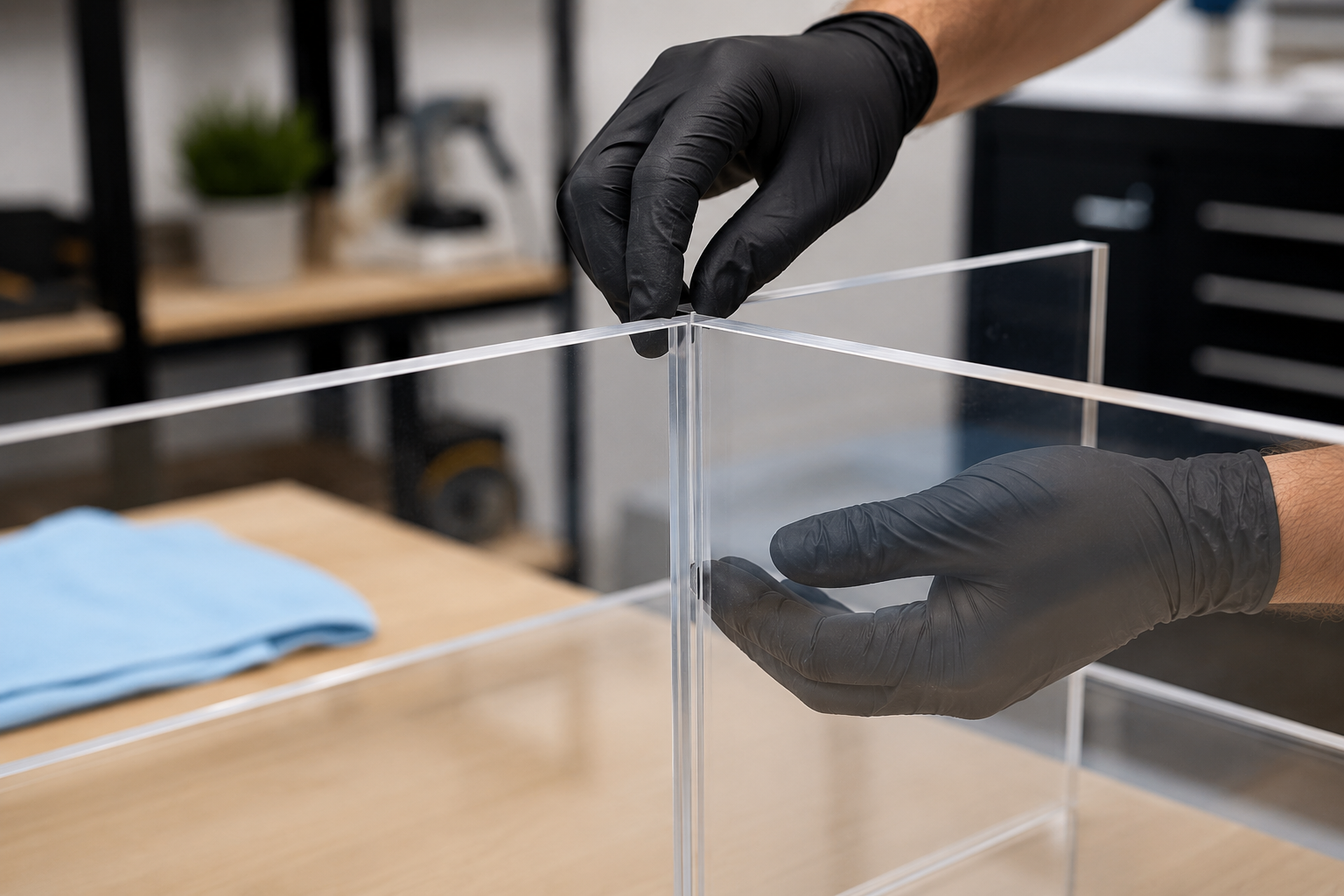
Whether you’re repairing a cracked acrylic display, manufacturing point-of-sale signage, fabricating protective guards or bonding acrylic to metal, selecting the correct adhesive is essential. Acrylic (commonly known by brand names such as Perspex® and Plexiglas®) offers excellent optical clarity and weather resistance, but using the wrong adhesive can result in stress cracking, whitening, weak bonds or complete bond failure.
In this guide, we’ll explain how to bond acrylic successfully, compare the best adhesive technologies available and help you choose the right product for your application. Whether you’re bonding acrylic to acrylic, aluminium, PVC, ABS or glass, we’ll cover the advantages and limitations of each adhesive.
What is Acrylic?
Acrylic (PMMA – Polymethyl Methacrylate) is a transparent thermoplastic widely used as a lightweight alternative to glass. It combines excellent optical clarity with good weather resistance, making it popular across many industries including:
- Retail displays
- Shop signage
- Machine guards
- Aquariums
- Automotive components
- Medical equipment
- LED lighting
- Furniture
- Exhibition stands
Although acrylic is relatively easy to machine, drilling or cutting can introduce internal stresses. Choosing the wrong adhesive may cause these stressed areas to crack over time, making adhesive selection extremely important. If you’re unfamiliar with the material itself, SpecialChem’s PMMA guide provides an excellent overview of acrylic’s mechanical properties, UV resistance and common industrial applications.
You may also find our guide Best Adhesive for Perspex and Polycarbonate: A Complete Guide useful.
Why Choosing the Right Adhesive Matters
Many general-purpose glues appear to bond acrylic initially but fail after exposure to vibration, UV light or temperature changes.
A suitable acrylic adhesive should provide:
- Excellent adhesion
- High impact strength
- UV resistance
- Long-term durability
- Good optical appearance where required
- Appropriate flexibility for thermal expansion
Understanding how to bond acrylic correctly begins with selecting an adhesive designed specifically for your application.
Surface Preparation
Before bonding acrylic, always prepare both surfaces correctly to achieve the strongest and most durable bond:
- Remove any dust, dirt or loose contamination from both bonding surfaces.
- Clean the surfaces using Isopropyl Alcohol (IPA) and a clean, lint-free cloth.
- Avoid using strong solvents such as acetone, as these can damage or stress crack acrylic.
- Allow both surfaces to dry completely before applying the adhesive.
- Lightly abrade non-visible bonding areas when using structural adhesives such as MMA or epoxy to improve adhesion.
- Do not abrade surfaces when using optically clear UV-curing adhesives, as this may reduce the clarity of the finished bond.
Cast Acrylic vs Extruded Acrylic
There are two main types of acrylic available, cast acrylic and extruded acrylic. While both offer excellent clarity and weather resistance, they differ in strength, machining properties and bonding performance.
Cast Acrylic
Cast acrylic is manufactured by pouring liquid acrylic resin into moulds before curing, resulting in a higher-quality material with lower internal stress.
Advantages
- Higher mechanical strength
- Better chemical resistance
- Superior optical clarity
- Lower internal stress, reducing the risk of stress cracking during bonding
- Better suited to machining and polishing
Common Applications
- Aquariums
- Retail display cases
- Museum showcases
- Premium signage
- Protective machine guards
- Medical equipment
- High-end furniture
- Architectural glazing
Bonding Suitability
Cast acrylic is generally the preferred choice for structural bonding and optically clear adhesive joints, offering more consistent long-term performance.
Extruded Acrylic
Extruded acrylic is produced by continuously forcing molten acrylic through rollers. It is typically more economical and easier to manufacture in large sheets.
Advantages
- Lower material cost
- Consistent sheet thickness
- Easier to cut and machine
- Suitable for high-volume manufacturing
Disadvantages
- Higher internal stress than cast acrylic
- Greater risk of crazing or stress cracking when exposed to aggressive solvents or unsuitable adhesives
- Slightly lower chemical resistance
Common Applications
- Point-of-sale displays
- Protective screens
- Signage
- Glazing panels
- Light diffusers
- Picture frames
- DIY projects
- General fabrication
Bonding Suitability
Extruded acrylic can be successfully bonded using the correct adhesive, but extra care should be taken during surface preparation and adhesive selection due to its higher internal stress. Always test the chosen adhesive on a small sample before full production, particularly for cosmetic or highly stressed applications.
Best Adhesives for Bonding Acrylic
Different applications require different adhesive technologies.
| Adhesive | Best For | Flexibility | Gap Filling | Optical Clarity |
|---|---|---|---|---|
| Permabond UV605 | Clear acrylic | Low | Poor | Excellent |
| Permabond UV610 | Glass & acrylic | Low | Poor | Excellent |
| Permabond TA4204 | Acrylic to plastics | Medium | Excellent | Opaque |
| Permabond TA4205 | Larger assemblies | Medium | Excellent | Opaque |
| Permabond ET5428 | Acrylic to metal | Medium | Excellent | Black or cream |
| Plexus MA300 | Structural acrylic bonding | Medium | Excellent | Black or off-white |
| Plexus MA310 | Larger structural joints | Medium | Excellent | Off-white |
| Plexus MA420 | Heavy-duty structural bonding | Medium | Excellent | Blue |
How to Bond Acrylic to Acrylic
For clear display cases or optical applications, UV-curing adhesives provide virtually invisible joints. Where appearance is less important and maximum strength is required, structural MMA adhesives are often preferred.
Permabond UV605
Best for:
- Display cabinets
- Trophy cases
- Clear signs
- Acrylic showcases
- Optical clarity
Working time: Unlimited until exposed to UV light.
Fixture time: Typically 10 to 30 seconds with suitable UV equipment.
Full cure: Within minutes depending on lamp intensity.
Buy here: Permabond UV605 50ml
When to use
✔ Clear joints
✔ Optical applications
✔ Transparent acrylic
When not to use
✖ Opaque materials
✖ Large gaps
✖ Hidden joints where UV light cannot penetrate
Plexus MA300
Best for
- Structural acrylic fabrication
- Machine guards
- Industrial assemblies
- Sign manufacture
Working time: Approximately 3 to 6 minutes.
Fixture time: Approximately 12 to 18 minutes.
Full cure: Approximately 24 hours.
Advantages
- Extremely high bond strength
- Excellent impact resistance
- Bonds without primers
- Excellent gap filling
Buy here: Plexus MA300
When to use
✔ Structural bonding
✔ Fabrication
✔ Heavy-duty assemblies
When not to use
✖ Invisible joints
✖ Optical bonding
For a slower cure version you can buy Plexus MA310
How to Bond Acrylic to Metal
Bonding acrylic directly to aluminium or steel requires an adhesive capable of handling different expansion rates.
Our preferred products are:
Permabond ET5428
ET5428 is a toughened epoxy adhesive offering excellent environmental resistance.
Working time: Approximately 5 minutes.
Handling strength: Around 30 minutes.
Full cure: 24 hours.
Benefits
- Excellent chemical resistance
- High peel strength
- Excellent vibration resistance
- Strong bond to aluminium and stainless steel
Best applications
- Machine guards
- Automotive panels
- Instrument housings
- Industrial equipment
When not to use
Not recommended where ultra-fast handling strength is required.
Buy now: Permabond ET5428 black or cream 50ml
Plexus MA310
MA310 provides a longer working time than MA300, making it ideal for larger fabricated assemblies.
Working time: Approximately 15 to 18 minutes.
Fixture time: Approximately 35 to 45 minutes.
Advantages
- Excellent structural performance
- Bonds difficult plastics
- High impact resistance
- Excellent fatigue performance
Recommended for
- Large signs
- Vehicle panels
- Composite structures
- Fabricated acrylic assemblies
How to Bond Acrylic to PVC
For bonding acrylic to PVC we generally recommend:
These toughened acrylic adhesives provide excellent adhesion whilst accommodating slight movement.
Permabond TA4204
Working time: Approximately 4 minutes.
Fixture time: Approximately 8 minutes.
Full cure: 24 hours.
Best for
- PVC fabrications
- Plastic housings
- Sign manufacture
When not to use
- Not suitable where completely invisible bond lines are required.
Buy now: Permabond TA4204
Permabond TA4205
Offers a longer working time than TA4204.
Ideal for
- Larger panels
- Complex positioning
- Multiple-part assemblies
Buy now: Permabond TA4205
How to Bond Acrylic to ABS
ABS bonds exceptionally well using:
- TA4204
- TA4205
- Plexus MA300
These products produce strong structural bonds while maintaining good impact resistance.
If you’re specifically bonding ABS components, read our guide:
Related Blog: Best Adhesive for Bonding ABS Plastic (Caravans)
How to Bond Acrylic to Glass
Where a completely transparent joint is required, UV-curing adhesives remain the best choice.
Recommended
- Permabond UV605
- Permabond UV610
UV adhesives cure only when exposed to ultraviolet light, allowing unlimited positioning time before curing begins.
Cure Time Comparison
| Product | Working Time | Fixture Time | Full Cure |
|---|---|---|---|
| UV605 | Unlimited | 10 to 30 sec | Minutes |
| UV610 | Unlimited | 15 to 45 sec | Minutes |
| TA4204 | 4 min | 8 min | 24 hrs |
| TA4205 | 8 min | 15 min | 24 hrs |
| ET5428 | 5 min | 30 min | 24 hrs |
| MA300 | 3 to 6 min | 12 to 18 min | 24 hrs |
| MA310 | 15 to 18 min | 35 to 45 min | 24 hrs |
| MA420 | Approximately 35 to 40 min | Around 90 min | 24 hrs |
Which Adhesive Should You Choose?
| Application | Recommended Product |
|---|---|
| Clear acrylic display | UV605 |
| Acrylic to glass | UV610 |
| Acrylic to aluminium | ET5428 |
| Acrylic to steel | ET5428 |
| Acrylic to PVC | TA4204 |
| Acrylic to ABS | TA4204 |
| Heavy structural acrylic | Plexus MA300 |
| Large fabricated panels | Plexus MA310 |
| High-strength structural assemblies | Plexus MA420 |
Common Mistakes
Avoid these common errors when learning how to bond acrylic:
- Using household super glue on large structural joints.
- Cleaning acrylic with acetone.
- Applying excessive clamping pressure.
- Bonding dirty or oily surfaces.
- Selecting an adhesive with insufficient working time.
- Ignoring thermal expansion between different materials.
Frequently Asked Questions
Can you glue acrylic together?
Yes. UV-curing adhesives provide almost invisible joints, while structural MMA adhesives provide extremely high bond strength for engineering applications.
What is the strongest adhesive for acrylic?
For structural applications, Plexus MA300, MA310 and Permabond ET5428 provide exceptionally strong bonds.
Can acrylic be bonded to aluminium?
Yes. Toughened epoxy and MMA adhesives are excellent choices due to their ability to accommodate differential expansion.
Can I use super glue?
Cyanoacrylate adhesives can work for small repairs but may cause whitening (blooming) and stress cracking. For permanent structural applications, specialist acrylic adhesives are recommended.
Conclusion
Learning how to bond acrylic starts with choosing the correct adhesive for your application. UV adhesives such as Permabond UV605 are ideal for clear optical bonds, while structural products including Permabond TA4204, ET5428 and the Plexus MA300, MA310 and MA420 range deliver outstanding strength for demanding industrial applications.
By selecting the correct adhesive and preparing the surfaces properly, you can achieve durable, professional-quality bonds across a wide variety of acrylic assemblies.
For expert advice on selecting the right adhesive, contact Adhesive Supply Company or browse our full range of industrial adhesives online.
Related Blogs
- Best Adhesive for Plastic
- Best Adhesive for Bonding ABS Plastic
- Best Adhesive for Glass
- UV Adhesives Explained
- Best Adhesive for Fibreglass Boat Repair