
Boats are exposed to some of the harshest environments possible. Constant vibration, UV exposure, temperature changes, moisture, saltwater, and mechanical stress can quickly cause poor-quality adhesives to fail. Choosing the correct adhesive for each boat material is essential for long-lasting repairs and reliable structural bonding.
In this boat repair adhesive guide, we cover the most common materials found on boats and explain which adhesive systems are best suited to each one. Whether you are repairing fibreglass panels, bonding aluminium trims, resealing deck fittings, or fixing cracked plastics, selecting the correct adhesive can make the difference between a permanent repair and another failure a few weeks later. This boat repair adhesive guide also explains when certain adhesives should be avoided, particularly on low surface energy plastics or flexible marine materials.
Materials Covered in This Guide
This boat repair adhesive guide covers:
- Fibreglass (GRP)
- Aluminium
- Stainless Steel
- ABS & Marine Plastics
- Acrylic & Perspex Windows
- Rubber Seals & Gaskets
- PVC & Inflatable Boat Materials
- Wood & Teak Decking
- Composite Panels
Why Boats Are Difficult to Bond
Boat repairs are far more demanding than many household or automotive applications. Adhesives used in marine environments must often withstand:
- Continuous vibration
- Flexing and movement
- Water and salt exposure
- UV degradation
- Thermal expansion
- Heavy impact loads
Using the wrong adhesive can lead to cracking, delamination, corrosion issues, or water ingress. Choosing the correct product is essential, which is why this boat repair adhesive guide compares flexible sealants, structural MMA adhesives, epoxies, and contact adhesives.
Best Adhesives for Fibreglass (GRP) Boat Repairs
Fibreglass, also known as GRP (Glass Reinforced Plastic), is one of the most common materials found on modern boats. It is used for hulls, decks, seating structures, and interior panels.
Common GRP Repair Issues
- Cracked panels
- Delamination
- Bonding new sections
- Structural reinforcement
- Vibration-related failures
Recommended Adhesives
Permabond ET5428
Permabond ET5428 is an excellent structural epoxy adhesive designed for composite bonding applications. It offers high impact resistance, strong peel strength, and excellent vibration resistance, making it ideal for marine fibreglass repairs.
Best for:
- Composite panel bonding
- Structural GRP repairs
- Fibreglass to metal bonding
Avoid using when:
- Fast repositioning is needed
- Extremely flexible joints are required
Plexus MA310 & MA420
Plexus MMA adhesives are widely used within marine manufacturing because of their exceptional strength and ability to bond composites and metals with minimal preparation.
Plexus MA310 is a versatile structural MMA adhesive offering excellent impact resistance and strong adhesion to fibreglass, metals, and many plastics. Its slightly more workable cure profile makes it well suited to general marine fabrication and fibreglass repair applications where positioning time is important.
Plexus MA420 is a higher-performance structural MMA adhesive designed for demanding marine environments requiring exceptional strength, fast fixture times, and outstanding fatigue resistance. It performs particularly well for bonding GRP to aluminium and other mixed material assemblies exposed to constant vibration and stress.
Best for:
- Hull bonding
Provides high structural strength with excellent resistance to impact, vibration, and long-term fatigue. - Fibreglass structural repairs
Creates durable bonds on GRP and composite materials while tolerating flex and movement better than many traditional epoxies. - Bonding GRP to aluminium
Excellent for mixed material bonding where thermal expansion differences would often cause brittle adhesives to crack over time.
Avoid using when:
- Cosmetic clear bonding is required
- Very thin delicate plastics are involved
Clear Structural Adhesive Options
Permabond TA4204
TA4204 was specifically developed as a crystal-clear structural acrylic adhesive, making it ideal where appearance matters as much as strength. It bonds metals, glass, GRP, composites and many plastics while maintaining a transparent bond line.
Best for:
- Clear plastic components
- Acrylic and Perspex assemblies
- Visible boat repairs
- Marine glazing
- Glass to metal bonding
Permabond TA4205
TA4205 offers similar strength and transparency to TA4204 but with a longer working time, making it easier to position larger components before the adhesive cures. Permabond launched both products as highly transparent structural MMAs for applications where aesthetics are important.
Best for:
- Larger panels
- Longer assembly times
- Visible structural joints
- Clear composite repairs
Best Adhesives for Aluminium Boat Repairs
Aluminium is commonly used for trims, rails, flooring systems, pontoons, and structural sections. The challenge with aluminium is oxidation. Proper preparation is essential before bonding.
Recommended Adhesives
Plexus MA420
Plexus MA420 provides excellent adhesion to aluminium and maintains strength under vibration and marine conditions.
Best for:
- Structural aluminium bonding
- Mixed material joints
- Marine fabrication
Permabond TA4205
Permabond TA4205 is a toughened acrylic adhesive with excellent impact resistance and gap-filling properties.
Best for:
- Aluminium brackets
- Trim repairs
- Small structural repairs
Avoid using when:
- Large cosmetic bond lines are visible
Arbokol 682
Arbokol 682 is ideal where sealing and flexibility are required alongside adhesion.
Best for:
- Marine sealing
- Flexible joints
- Preventing water ingress
Best Adhesives for ABS & Marine Plastics
Many boats contain ABS plastics within dashboards, hatch surrounds, instrument panels, storage compartments, and interior trims. Over time these plastics can become brittle due to UV exposure, vibration, and temperature cycling.
Choosing the correct adhesive depends on whether the repair requires flexibility, cosmetic appearance, or structural strength.
Recommended Adhesives
Permabond TA4205
TA4205 performs very well on many engineering plastics and provides a durable repair with excellent impact resistance and gap-filling properties. Its clear appearance also makes it suitable for visible cosmetic repairs.
Best for:
- Cracked ABS panels
- Marine trim repairs
- Plastic-to-metal bonding
- Visible bond lines
Plexus MA310
Plexus MA310 is ideal for more demanding structural plastic repairs where high strength and vibration resistance are required. It bonds exceptionally well to composites, metals, and many marine plastics.
Best for:
- Structural hatch repairs
- Heavy-duty plastic bonding
- Fibreglass-to-plastic assemblies
- High vibration areas
Avoid using when:
- A cosmetically clear bond line is required
- Very thin delicate plastics are involved
Permabond TA4610 & TA4611
Permabond TA4610 and TA4611 are toughened cyanoacrylate adhesives designed for rapid bonding of difficult plastic components. TA4611 offers improved gap filling where broken or uneven parts need rebuilding.
Best for:
- Snapped clips and tabs
- Small ABS repairs
- Fast maintenance repairs
- Tight-fitting plastic components
Avoid using when:
- Large structural gaps are present
- Continuous flexing or movement occurs
HB42 All-In-One Adhesive
HB42 is useful for general marine maintenance repairs where flexibility and ease of use are important. It performs best on high surface energy materials commonly found around boats such as fibreglass, painted metals, wood, ceramics, and some rigid plastics including ABS.
Best for:
- Interior trim repairs
- Bonding mixed materials
- General maintenance repairs
- Flexible waterproof sealing
Avoid using when:
- Structural load-bearing repairs are needed
- Bonding low surface energy plastics such as polypropylene (PP) or polyethylene (PE) without specialist primers or surface treatment
Best Adhesives for Acrylic & Perspex Boat Windows
Boat windows are commonly manufactured from acrylic or Perspex materials. These materials can craze or crack if the wrong adhesive is used.
Arbomeric MP20
Arbomeric MP20 provides a flexible weatherproof seal suitable for marine glazing applications.
Best for:
- Window sealing
- Flexible bonding
- UV-resistant joints
Avoid using:
- Aggressive solvent-based adhesives
- Brittle super glues
Boat Adhesive Repair Guide Rubber Seals & Gaskets
Rubber materials are used throughout boats for hatch seals, anti-vibration pads, marine gasketing, deck fittings, insulation strips, and weatherproof sealing. These materials are constantly exposed to moisture, UV exposure, movement, and temperature changes, so choosing the correct adhesive is important for long-term durability.
Recommended Products
Bostik 2402
Bostik 2402 is a high-performance solvent-based contact adhesive widely used for bonding rubber materials in demanding industrial and marine environments. It provides excellent initial grab, strong flexibility, and good resistance to moisture, making it particularly suitable for marine sealing and rubber bonding applications.
Best for:
- Rubber to metal bonding
- Rubber seals and gaskets
- Marine gasketing
- Inflatable boat repairs
- Bonding neoprene, foam, and flexible rubber materials
- Anti-vibration rubber strips and pads
Avoid using when:
- Large structural gaps exist
- Continuous heavy structural loads are present
- Bonding rigid structural assemblies requiring high peel or shear strength
For best results, surfaces should be clean, dry, and lightly abraded before adhesive application.
Arbo Butyl Tapes
Butyl tapes such as Arbo GZ Butyl Tape are ideal for waterproof sealing applications around marine fittings, joints, trims, and overlapping panels. Unlike traditional curing sealants, butyl tapes remain permanently flexible and tacky, allowing them to maintain a watertight seal even when exposed to vibration, movement, and thermal expansion.
This makes them particularly popular within the marine industry for sealing deck hardware and preventing long-term water ingress without creating a brittle joint that may crack over time.
Butyl tapes are also advantageous because they are non-hardening, easy to apply, and allow fittings to be removed or serviced more easily compared to fully cured structural adhesives.
Best for:
- Deck fittings
- Waterproof sealing
- Compression seals
- Marine window sealing
- Hatch surrounds
- Aluminium trim sealing
- Preventing water ingress around screws and fasteners
Avoid using when:
- Structural bonding strength is required
- Large unsupported gaps are present
- Permanent rigid load-bearing joints are needed
For best performance, surfaces should be clean, dry, and free from oil or oxidation before application.
Boat Repair Adhesive Guide for PVC & Inflatable Boat Materials
Inflatable boats, dinghies, and RIBs (Rigid Inflatable Boats) commonly use flexible PVC or Hypalon materials which require specialist adhesive systems capable of handling constant flexing, vibration, UV exposure, and water immersion.
Unlike rigid fibreglass or metal repairs, inflatable boat materials expand and flex continuously during use. Standard rigid adhesives can quickly crack or delaminate, particularly around seams and high-stress areas. Whether you are repairing a fibreglass hull, sealing deck fittings, or patching an inflatable boat, this boat repair adhesive guide covers the most suitable adhesive options.
Recommended Adhesives
Bostik 2404 Two Part Set
Bostik 2404 Two Part Adhesive is a high-performance contact adhesive system specifically designed for demanding flexible bonding applications. When mixed with Bostikure hardener, it provides improved heat resistance, water resistance, and durability, making it particularly suitable for inflatable boat repairs and marine fabric bonding.
The adhesive remains flexible after curing, allowing it to move with PVC and Hypalon materials without becoming brittle or cracking over time.
It is widely used for:
- Inflatable boat repairs
- RIB tube patching
- Flexible PVC bonding
- Hypalon repairs
- Re-bonding inflatable seams
- Marine fabric and rubber applications
Best for:
- Patch repairs
- Inflatable seams
- Flexible PVC bonding
- Rubberised fabric repairs
- High-flex marine materials
Avoid using:
- Rigid epoxies
- Brittle acrylic adhesives
- Structural load-bearing rigid assemblies
For best results, surfaces should be thoroughly cleaned and lightly abraded before application. Correct surface preparation is especially important with inflatable materials due to contamination from salt, oils, UV exposure, and plasticisers commonly found in marine environments. This boat repair adhesive guide also highlights why flexible marine materials such as PVC and rubber require completely different adhesive technologies compared to rigid composites or aluminium.
Boat Repair Adhesive Guide for Wood & Teak Decking
Wood and teak decking used on boats are constantly exposed to moisture, UV exposure, saltwater, and temperature fluctuations. Unlike rigid materials, timber naturally expands and contracts as humidity and temperature change, meaning marine adhesives must be capable of handling movement without cracking or losing adhesion over time.
Teak decking in particular is commonly used on yachts, cruisers, and leisure boats because of its durability and appearance, but it can be difficult to bond due to its natural oils and movement characteristics.
Recommended Adhesives
HB42 All-In-One
HB42 All-In-One is a flexible MS polymer adhesive and sealant suitable for many marine timber applications where weather resistance and flexibility are important. It provides strong adhesion to wood, fibreglass, painted metals, and many composite materials commonly found on boats.
Because it remains flexible after curing, HB42 can accommodate natural expansion and contraction within timber decking far better than brittle rigid adhesives.
Best for:
- Deck trims
- Marine wood panels
- Interior timber sections
- Flexible timber bonding
- General boat maintenance repairs
Avoid using when:
- Constant full water immersion is present
- Heavy structural load-bearing joints are required
- Low surface energy plastics such as PP or PE are involved
Arbomeric MP20
Arbomeric MP20 is particularly useful where both sealing and flexibility are equally important. Its flexible cure and weather resistance make it suitable for marine joints exposed to vibration, movement, and moisture ingress.
It works well around deck trims, timber joints, hatch surrounds, and other marine areas where a watertight flexible seal is required alongside adhesion.
Best for:
- Deck trims
- Teak sections
- Marine wood panels
- Flexible sealing joints
- Waterproof marine detailing
Avoid using when:
- High structural bonding strength is required
- Large unsupported gaps are present
- Rigid mechanical fixing replacement is needed
For best results with wood and teak decking, surfaces should be clean, dry, and lightly abraded before bonding. Oily hardwoods such as teak may require additional cleaning and preparation to achieve optimal adhesion.
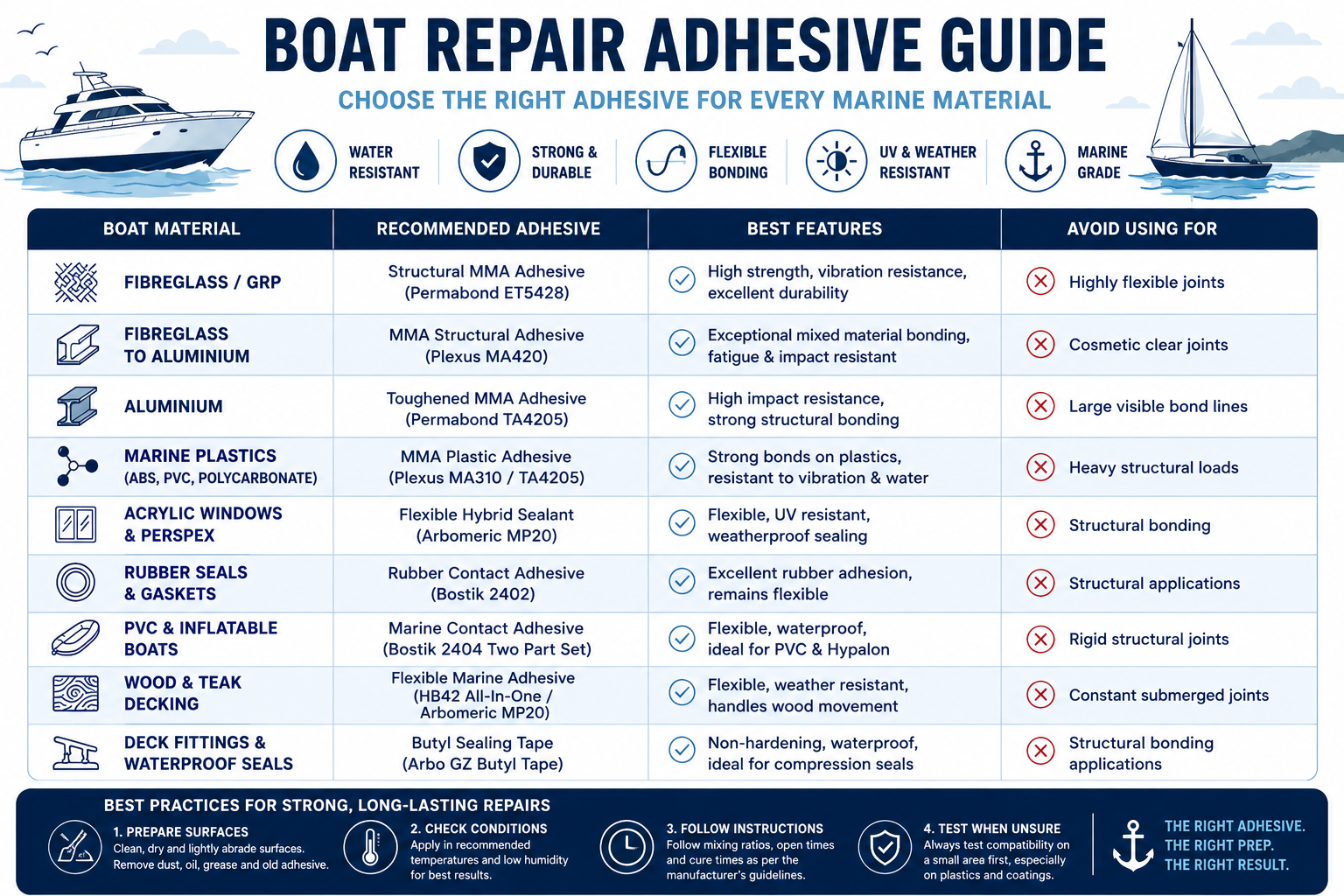
Boat Repair Adhesive Guide Comparison Chart
| Boat Material | Recommended Adhesive | Best Features | Avoid Using For |
|---|---|---|---|
| Fibreglass / GRP | Permabond ET5428 | Structural strength, composite bonding & vibration resistance | Highly flexible joints |
| Fibreglass to Aluminium | Plexus MA420 | Exceptional mixed material bonding & fatigue resistance | Cosmetic clear joints |
| Aluminium | Permabond TA4205 | Toughened impact resistance with clear bond lines | Large structural unsupported joints |
| ABS & Marine Plastics | Plexus MA310 / TA4205 | Strong plastic bonding with excellent vibration resistance | Very thin delicate plastics |
| Small Plastic Repairs | Permabond TA4610 / TA4611 | Fast curing repair adhesive for clips, trims & tabs | Large structural gaps |
| Marine Maintenance Repairs | HB42 All-In-One | Flexible waterproof bonding on high energy surfaces | Heavy structural loads & low surface energy plastics |
| Acrylic & Perspex Windows | Arbomeric MP20 | Flexible weatherproof sealing with UV resistance | Structural bonding |
| Rubber Seals & Gaskets | Bostik 2402 | Strong flexible rubber adhesion | Structural load-bearing applications |
| PVC & Inflatable Boats | Bostik 2404 Two Part Set | Flexible waterproof bonding for PVC & Hypalon materials | Rigid structural joints |
| Wood & Teak Decking | HB42 / Arbomeric MP20 | Flexible outdoor bonding & sealing | Constant submerged structural joints |
| Deck Fittings & Waterproof Seals | Arbo GZ Butyl Tape | Non-hardening waterproof compression sealing | Structural bonding applications |
As shown throughout this boat repair adhesive guide, choosing the correct adhesive for each marine material is essential for achieving long-lasting repairs that can withstand moisture, vibration, UV exposure, and constant movement.
Common Mistakes When Repairing Boats
As discussed in this boat repair adhesive guide, many marine repair failures occur because the adhesive chosen cannot tolerate long-term flexing or environmental exposure.
Common mistakes include:
- Using brittle super glue on vibrating components
- Bonding dirty oxidised aluminium
- Using rigid epoxies on flexible plastics
- Choosing silicone where paintability is required
- Ignoring proper surface preparation
Proper cleaning, abrasion, and degreasing are critical for successful boat repairs.
Boat Repair Adhesive Guide – Final Thoughts
Choosing the correct adhesive for marine repairs depends heavily on the materials involved, the amount of movement present, and exposure to moisture and UV.
This boat repair adhesive guide highlights why there is no single “best glue” for every repair. Structural fibreglass repairs may require a high-performance epoxy such as Permabond ET5428, while flexible sealing applications may be better suited to Arbomeric MP20 or butyl tapes.
Understanding the substrate and environmental conditions is the key to achieving a durable long-lasting repair.
For further information on marine material performance and composite repair standards, the British Marine industry association provides useful guidance:
https://www.britishmarine.co.uk/