
Cracked ABS plastic is one of the most common caravan and motorhome repair problems. From front and rear panels to wheel arches, trims, corner mouldings and storage compartments, ABS is used extensively because it is lightweight, weather resistant, and easy to form into complex shapes.
The problem is that ABS plastic expands and flexes constantly while travelling. Add UV exposure, vibration, temperature changes, accidental knocks, or stress around fixings, and cracks can quickly appear.
Choosing the best adhesive for caravan ABS plastic repair is important because the wrong product can fail surprisingly quickly outdoors. Many DIY fixes become brittle, shrink, or lose adhesion after a few months of movement and weather exposure.
In this guide, we’ll explain how to identify ABS plastic, which adhesives work best, how to prepare the surface properly, and which products are best suited for structural repairs, flexible bonding, or cosmetic crack repairs.
For broader caravan body repairs, see our guides on:
- Best Adhesive for Caravan Panel Repair
- Best Adhesive for Caravan Trim Repair
- Best Adhesive for Composite Bonding
- Best Adhesive for Caravan Delamination Repair (UK Guide)
- Best Adhesive for Caravan Floor Repair (UK Guide)
- Best Adhesive for Caravan Roof Repair (UK Guide)
- Best Adhesive for Caravan Leak Repair (UK Guide)
What Is ABS Plastic on a Caravan?
ABS (Acrylonitrile Butadiene Styrene) is a rigid thermoplastic commonly used on:
- Front and rear caravan panels
- Wheel arch covers
- Storage box housings
- Corner trims
- Exterior mouldings
- Access covers
- Motorhome body components
You can usually recognise ABS because it:
- Has a smooth moulded finish
- Feels rigid but slightly flexible
- Is commonly white, cream, or grey
- Can crack rather than bend when stressed
Many caravan owners assume fibreglass and ABS are the same material, but they behave very differently when repaired.
Why ABS Plastic Repairs Fail
A lot of failed caravan repairs come down to using the wrong adhesive.
Common mistakes include:
- Using household silicone
- Using brittle superglue
- Bonding over dirt or oxidation
- Not abrading the surface
- Choosing rigid fillers on flexible panels
ABS expands and contracts outdoors, especially on caravans left in direct sunlight. A repair that feels strong initially can fail once vibration and thermal movement begin.
This is why the best adhesive for caravan ABS plastic repair is usually either:
- A structural MMA adhesive
- A flexible polyurethane
- A toughened epoxy
depending on the type of repair.
Adhesive bonding is widely recognised as an effective method for joining plastics and composite materials because it distributes stress more evenly than mechanical fixings.
Best Adhesives for Caravan ABS Plastic Repair
1. Best Overall Structural Repair
ITW Plexus MA310 Structural Adhesive
Plexus MA310 is one of the strongest options when choosing the best adhesive for caravan ABS plastic repair where long-term structural strength matters.
Best for:
- Cracked ABS panels
- Caravan front and rear panels
- Structural body repairs
- Bonding ABS to aluminium or GRP
Why it works:
- Extremely high bond strength
- Handles vibration well
- Excellent gap filling
- Fast curing
Unlike many rigid epoxies, MMA adhesives tolerate movement better, making them ideal for caravan body repairs.
2. Best Flexible Outdoor Repair
Arbothane 1245 Polyurethane Adhesive
Where flexibility matters more than ultimate structural strength, Arbothane 1245 is often the safest option.
Best for:
- Exterior trims
- Wheel arch repairs
- Flexible ABS sections
- Outdoor waterproof repairs
Why it works:
- Flexible after cure
- Weather resistant
- UV resistant
- Bonds mixed materials well
Polyurethane adhesives are commonly used in transport applications because they absorb vibration and movement while remaining waterproof. Arbothane 1245 can bond ABS plastic successfully where flexibility and weather resistance are priorities, making it suitable for trims, mouldings and vibration-prone exterior sections. For higher-strength structural ABS repairs, structural MMA adhesives such as Plexus MA310 are typically preferred.
Read more on arbothane Arbothane 1245 Adhesive: High-Performance Properties, Uses & Application Guide
3. Best for Crack Reinforcement
Permabond ET5428 Toughened Epoxy
For cracked areas that need reinforcing from behind, ET5428 is an excellent option.
Best for:
- Reinforcing cracked ABS
- Backing plates
- High-stress areas
- Filling damaged sections
Why it works:
- Toughened epoxy formula
- Improved impact resistance
- Good gap filling
- Sands well after cure
Avaliable in off-white or black colouring can also help hide darker repairs.
4. Best for Bonding + Sealing
HB42 Ultimate Adhesive & Sealant
Sometimes you need sealing and bonding in one step. h
Best for:
- Trim repairs
- Light-duty ABS repairs
- Sealing joints
- External mouldings
Why it works:
- Flexible finish
- Easy application
- No mixing required
- Good weather resistance
Ideal where convenience and sealing are priorities.
___________________________________________________________________________________________________________________________________________________________________________
Where Does Sikaflex Fit?
Products such as Sika Sikaflex 221 or 522 are commonly used in caravan and motorhome applications where flexibility and weather sealing are priorities. These products can work well for trims, mouldings, sealing joints, and lower-stress ABS repairs. However, for structural ABS crack repairs or high-load body panel repairs, structural MMA adhesives such as Plexus MA310 will generally provide significantly higher strength.
Adhesive Comparison Chart
| Repair Type | Recommended Product | Strength | Flexibility | Best Use |
|---|---|---|---|---|
| Structural ABS crack repair | Plexus MA310 | Very High | Medium | Permanent caravan body repairs |
| Flexible outdoor repair | Arbothane 1245 | High | High | Wheel arches & trims |
| Reinforcement repair | Permabond ET5428 | Very High | Low-Medium | Reinforcing damaged areas |
| Bonding + sealing | HB42 | Medium | High | Trim & sealing repairs |
How to Prepare ABS Plastic Properly
Even the best adhesive for caravan ABS plastic repair will fail if preparation is poor.
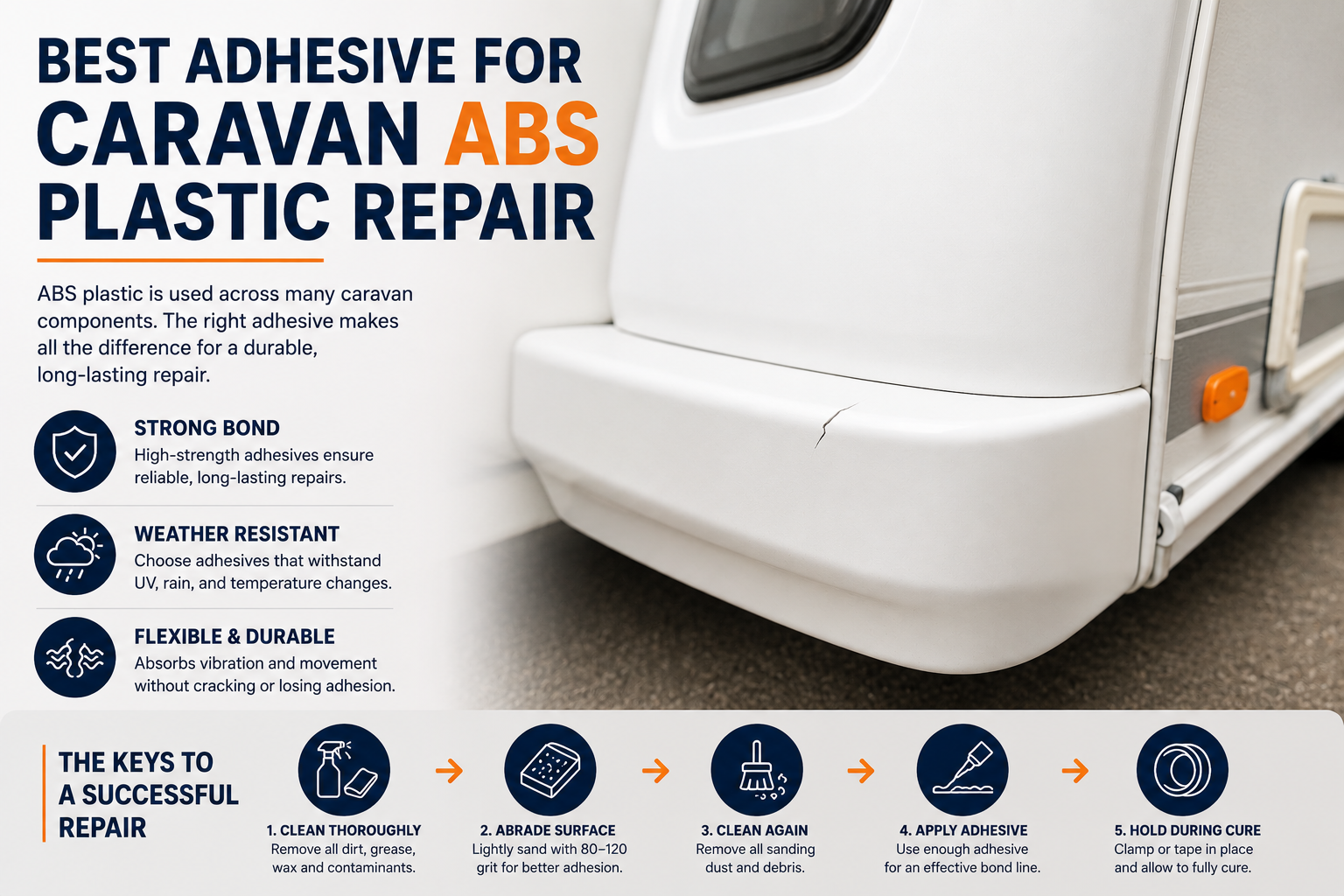
- Step 1: Clean Thoroughly
- Remove:
- Wax
- Dirt
- Silicone residue
- Grease
- Oxidised surface contamination
- Use isopropyl alcohol where possible or IPA wipes
- Remove:
- Step 2: Abrade the Surface
- Lightly abrade using:
- 80 to 120 grit abrasive paper
- This creates a mechanical key and significantly improves adhesion.
- Lightly abrade using:
- Step 3: Clean Again
- Remove all sanding dust before applying adhesive.
- Step 4: Apply Enough Adhesive
- Avoid applying too little product.
- Adhesives require sufficient bond line thickness to absorb movement properly.
- Step 5: Hold During Cure
- Clamp gently or tape the repair into position while curing.
- Avoid excessive pressure that squeezes the adhesive out completely.
How to Identify ABS vs GRP
This matters because adhesive choice changes depending on material.
| Material | Appearance | Typical Use | Feel |
|---|---|---|---|
| ABS Plastic | Smooth moulded finish | Trims & panels | Slightly flexible |
| GRP / Fibreglass | Fibrous underside | Structural panels | More rigid |
| PVC Trim | Softer plastic | Decorative edging | Flexible |
If you are bonding fibreglass and aluminium together, our guide on How to Glue Fibreglass to Metal may also help.
Colour Matching After Repair
Visible repairs often need cosmetic finishing afterwards.
White Repairs
- MA310 blends reasonably well with white caravans
- Can be painted after sanding
Black Repairs
- ET5428 hides darker repairs well
- Useful around wheel arches or shadowed areas
Paint Finishing
Many caravan repairs are lightly filled, sanded, primed, and painted afterwards for a near-factory finish. It’s important to wait for bond to be fully cured before any finishes are made.
Common ABS Repair Mistakes
Choosing the best adhesive for caravan ABS plastic repair can make the difference between a long-lasting repair and a crack that reappears within months. Many DIY products claim to bond plastic, but not all are suitable as the best adhesive for caravan ABS plastic repair in outdoor conditions. Avoid:
- Using household silicone ❌
- Bonding dirty surfaces ❌
- Using brittle fillers ❌
- Skipping abrasion ❌
- Disturbing the repair too early ❌
Many caravan ABS repairs fail due to preparation rather than adhesive strength.
Final Verdict
The best adhesive for caravan ABS plastic repair depends on the repair type.
- Structural cracks and permanent repairs → Plexus MA310
- Flexible exterior sections → Arbothane 1245
- Reinforcement and filling → ET5428
- Bonding and sealing together → HB42
For most caravan and motorhome repairs, choosing an adhesive that can tolerate vibration and outdoor movement is far more important than simply choosing the hardest adhesive available.
For additional information on ABS plastics and their properties in transport and exterior applications, the British Plastics Federation provides useful background on ABS material characteristics and durability.
Hi, your website is going to be really useful. I wonder if you can point me in the direction of any companies who could inspect my Mink Sports trailer for an assessment of internal cracking and whether it’s a manufacturing issue? Thank you