

Water ingress is one of the biggest problems caravan and motorhome owners face. Left untreated, even a small leak can lead to delamination, rotten timber, mould, damaged insulation and expensive structural repairs. Choosing the best adhesive for caravan leak repair is therefore critical if you want a long-lasting repair rather than a temporary patch.
In this guide, we’ll explain how to identify common caravan materials, which adhesive or sealant works best for each area, when not to use certain products, and which repair methods offer the most durable results.
Choosing the best adhesive for caravan leak repair depends on whether the repair is structural, flexible or purely waterproofing.
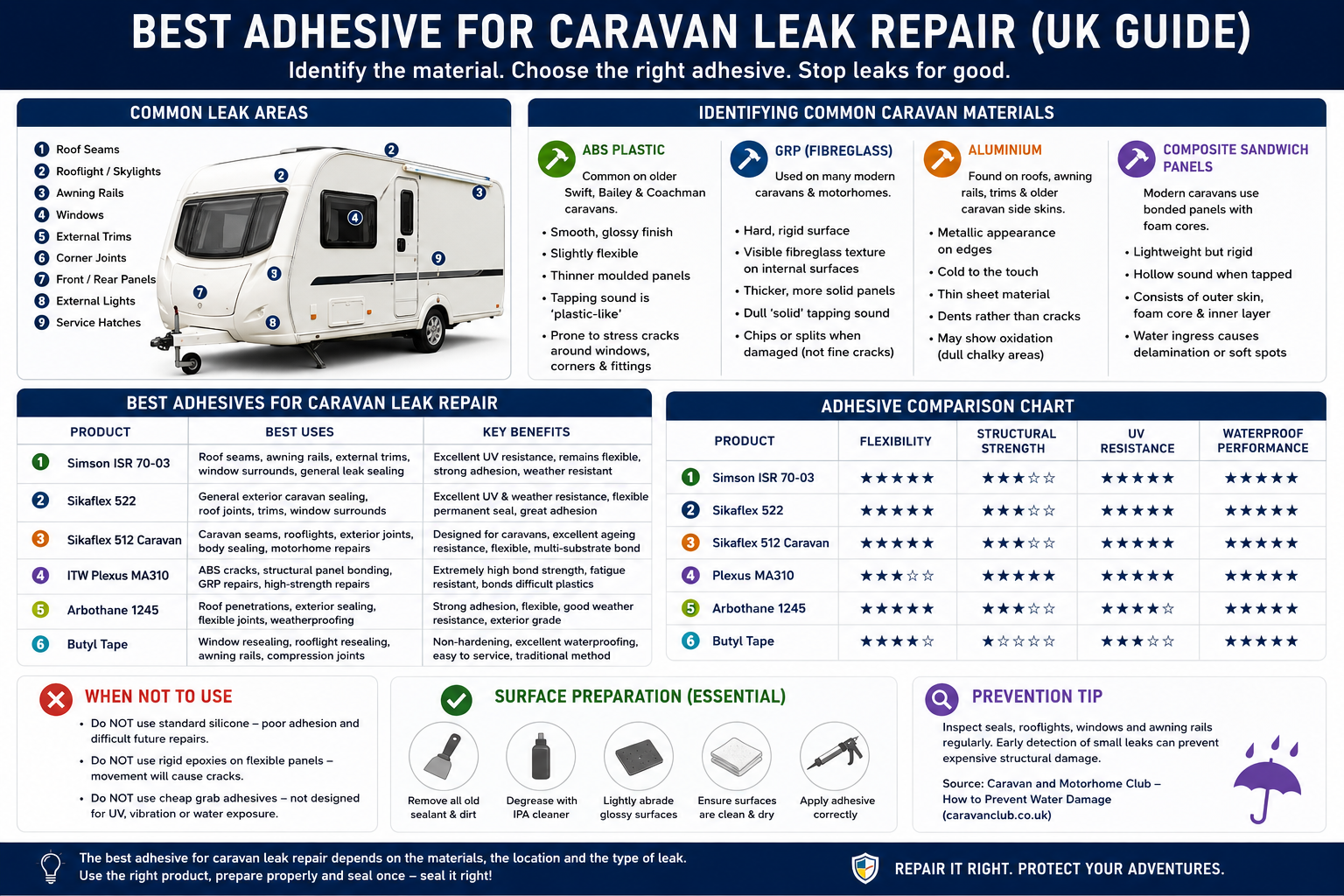
What Causes Caravan Leaks?
Most caravan leaks occur around:
- Windows
- Rooflights/skylights
- Awning rails
- Corner trims
- Roof seams
- External lights
- Panel joints
- Cracked ABS or GRP panels
Over time, vibration, UV exposure, temperature changes and movement weaken factory sealants and joints. According to the Caravan and Motorhome Club, failed seams and seals are one of the most common causes of water ingress in caravans. For caravan delamination applications read our guide Best Adhesive for Caravan Delamination Repair (UK Guide)
How to Identify Common Caravan Materials
Understanding the materials used in your caravan is essential when choosing the best adhesive for caravan leak repair for a durable and professional result.
| Caravan Part | Common Material | Typical Repair Method |
|---|---|---|
| Front/rear panels | ABS plastic | Structural MMA adhesive |
| Roof skins | Aluminium or GRP | Hybrid sealant or structural adhesive |
| Side walls | GRP/composite sandwich panel | Structural panel adhesive |
| Windows/skylights | Acrylic/polycarbonate | Flexible bonding sealant |
| Awning rails | Aluminium | Butyl tape + sealant |
| Internal floor | Plywood/composite | Floor repair adhesive |
ABS Plastic
ABS (Acrylonitrile Butadiene Styrene) was widely used on many UK caravans, particularly older Swift, Bailey, Lunar and Coachman models for front and rear body panels.
You can usually identify ABS by:
- A smooth glossy plastic finish
- Slight flexibility when pressed
- Thinner moulded panels with curved shapes
- Hairline stress cracks around windows, grab handles and corners
- A “plastic” tapping sound rather than a solid fibreglass feel
ABS panels are prone to:
- UV degradation
- Stress cracking
- Expansion and contraction from heat
- Cracks radiating from fixing points
Older ABS caravan panels often become brittle over time, especially on caravans stored outdoors. This is why structural MMA adhesives such as Plexus MA310 are commonly used for repairs, as they retain strength under vibration and movement.
If sanded lightly, ABS usually produces a fine plastic dust and may soften slightly under aggressive abrasion or heat.
GRP (Fibreglass)
GRP (Glass Reinforced Plastic), also known as fibreglass, is now extremely common on modern caravans and motorhomes because it is stronger and more impact resistant than ABS.
You can usually identify GRP by:
- A harder, more rigid feel than ABS
- Slight visible fibreglass texture on internal surfaces
- Thicker and more solid panels
- Less flex when pressed
- A duller “solid” tapping sound
- White fibrous strands sometimes visible on damaged edges
GRP is much less prone to stress cracking than ABS and offers:
- Better structural strength
- Improved water resistance
- Better UV durability
- Greater impact resistance
Modern GRP caravans often advertise “hail-resistant” or “GRP-clad” construction as a selling point.
When damaged, GRP tends to chip, split or delaminate rather than develop fine spider cracks like ABS. Structural MMA adhesives and composite repair systems are commonly used for GRP caravan repairs.
Aluminium
Aluminium is commonly found on:
- Older caravan roof skins
- Awning rails
- Corner trims
- Exterior mouldings
- Side skins on older caravans
You can usually identify aluminium by:
- Metallic appearance on unfinished edges
- Cold feel to the touch
- Thin sheet construction
- Small dents rather than cracks
- Oxidised dull silver appearance on older caravans
Older aluminium caravan skins are usually very thin and can deform easily during repairs. They also expand and contract considerably with temperature changes, which is why flexible sealants and hybrid adhesives are often preferred over rigid epoxies.
If lightly sanded, aluminium will expose a bright metallic finish underneath any oxidised layer.
Corrosion can also occur around steel fixings where galvanic reaction has taken place.
Composite Sandwich Panels
Most modern caravans now use composite sandwich panel construction for walls, roofs and floors. These panels typically consist of:
- An outer GRP or aluminium skin
- Internal foam insulation core
- Internal plywood or composite liner
- Bonded structural adhesive layers
You can usually identify composite sandwich panels by:
- Thick but lightweight construction
- Hollow sound when tapped
- Very rigid flat surfaces
- No visible internal framework from outside
- Delamination or “soft spots” if water ingress occurs
When water penetrates a composite panel, the adhesive bond between layers can fail, leading to:
- Soft walls
- Floor sponginess
- Bulging panels
- Delamination
This is one of the most serious caravan repair issues because the structural integrity of the panel itself can become compromised.
Modern caravan manufacturing relies heavily on structural adhesive bonding for these panels, which is why products such as structural MMAs and hybrid adhesives are widely used during both manufacture and repair.
Best Adhesives for Caravan Leak Repair
1. Simson ISR 70-03
Best for flexible exterior sealing and waterproof joints.
Buy here:
Simson ISR 70-03
Ideal for:
- Roof seams
- Awning rails
- External trims
- Window surrounds
- General leak sealing
Benefits:
- Excellent UV resistance
- Remains flexible
- Strong adhesion to multiple substrates
- Weather resistant
- Excellent long-term vibration resistance
2. Sikaflex 522
Best for caravan sealing, trims and exterior waterproof joints.For roof seams and window surrounds, the best adhesive for caravan leak repair is often a high-quality hybrid sealant or butyl sealing system.
Buy here:
Sikaflex 522 300ml
Ideal for:
- Exterior caravan sealing
- Roof joints
- Window surrounds
- Awning rails
- Exterior trim bonding
Benefits:
- Excellent UV and weather resistance
- Flexible permanent seal
- Good adhesion to caravan materials
- Solvent and isocyanate free
- Popular within caravan and motorhome repair industries
3. ITW Plexus MA310
Best for structural caravan crack repairs. If the caravan has stress cracks or delaminating panels, the best adhesive for caravan leak repair may need to be a structural MMA adhesive rather than a flexible sealant.
Buy here:
ITW Plexus MA310
Ideal for:
- ABS crack repairs
- Structural panel bonding
- GRP repairs
- High-strength permanent repairs
Benefits:
- Extremely high bond strength
- Excellent fatigue resistance
- Bonds difficult plastics
- Suitable for structural repairs
- Excellent for stress cracks and panel reinforcement
4. Arbothane 1245
Best for flexible exterior waterproof bonding.
Buy here:
Arbothane 1245
Ideal for:
- Roof penetrations
- Exterior sealing
- Flexible joints
- Weatherproof sealing
Benefits:
- Strong adhesion
- Flexible movement capability
- Good weather resistance
- Suitable for exterior use
5. Butyl Tape
Best for resealing windows and awning rails.
Buy here:
Butyl Sealant Tape
Ideal for:
- Window resealing
- Rooflight resealing
- Awning rails
- Compression joints
Benefits:
-
- Non-hardening
- Excellent waterproofing
- Traditional caravan repair method
- Easy to service later
- Ideal for serviceable joints
Comparison Chart
| Product | Best Use | Flexibility | Structural Strength | UV Resistance | Waterproof |
|---|---|---|---|---|---|
| Simson ISR 70-03 | Exterior seams & trims | Excellent | Medium | Excellent | Excellent |
| Sikaflex 522 | General exterior caravan sealing | Excellent | Medium | Excellent | Excellent |
| Sikaflex 512 Caravan | Caravan seams & motorhome joints | Excellent | Medium | Excellent | Excellent |
| Plexus MA310 | Structural crack repair | Medium | Excellent | Excellent | Excellent |
| Arbothane 1245 | Flexible waterproof joints | Excellent | Medium | Excellent | Excellent |
| Butyl Tape | Window & awning rail resealing | High | Low | Good | Excellent |
When NOT to Use Certain Adhesives
Do NOT Use Silicone Sealant
Standard bathroom or DIY silicone is one of the biggest mistakes in caravan repair.
Problems include:
- Poor long-term adhesion
- Difficult future repairs
- Dirt contamination
- Can fail under vibration
Do NOT Use Rigid Epoxies on Flexible Panels
Many caravan bodies flex during towing. Rigid adhesives can crack over time.
Do NOT Use Cheap Grab Adhesives
Most grab adhesives are not designed for:
- UV exposure
- Constant vibration
- Water immersion
- Thermal expansion
Surface Preparation Tips
Even the best adhesive for caravan leak repair can fail without correct preparation.
Recommended Preparation
- Remove all failed sealant
- Degrease thoroughly using IPA
- Lightly abrade glossy surfaces
- Ensure surfaces are dry
- Apply adhesive in recommended temperatures
For caravan leak repairs, preparation is often more important than the adhesive itself.
Common Leak Areas to Inspect
Regular inspection of seals, rooflights and awning rails is recommended by the Caravan and Motorhome Club to help prevent costly structural water damage and delamination repairs.
Around Windows
Look for:
- Soft wallboard
- Black staining
- Loose seals
- Damp smells
Rooflights & Skylights
Common due to UV degradation and movement.
Awning Rails
Screw holes and rail joints are frequent ingress points.
Front & Rear ABS Panels
Stress cracking is common, particularly around handles and windows.
Related Caravan Repair Guides
You may also find these guides useful:
- Best Adhesive for Caravan ABS Plastic Repair (UK Guide)
- Best Adhesive for Caravan Window Bonding (UK Guide)
- Best Adhesive for Caravan Roof Repair (UK Guide)
- Best Adhesive for Caravan Floor Repair (UK Guide)
- Best Adhesive for Caravan Delamination Repair (UK Guide)
- Best Adhesive for Caravan Panel Repair (GRP, Aluminium & Composite)
Final Thoughts
Choosing the best adhesive for caravan leak repair depends on the type of leak, the materials involved and whether the repair is structural or purely waterproofing.
For flexible waterproof sealing, hybrid sealants such as Simson ISR 70-03 are often the best choice. For structural caravan crack repairs, a high-strength MMA adhesive such as Plexus MA310 is typically the stronger long-term option.
Catching leaks early is essential. Small damp issues can quickly become major structural repairs if ignored. Regular inspection of seams, windows, rooflights and awning rails can save thousands in future repair costs. Using the best adhesive for caravan leak repair can help prevent water ingress, mould growth and expensive structural damage.