

Bonding rubber to metal sounds simple until the wrong adhesive peels away, slides under load, or fails when exposed to water, vibration, oil, or temperature changes. Rubber is flexible. Metal is rigid. They expand differently, move differently, and often live in harsh environments. That means choosing the best adhesive for rubber to metal depends heavily on the rubber type, metal surface, and service conditions.
In this guide, we’ll explain what actually works, what fails, and which adhesive type is best for your application.
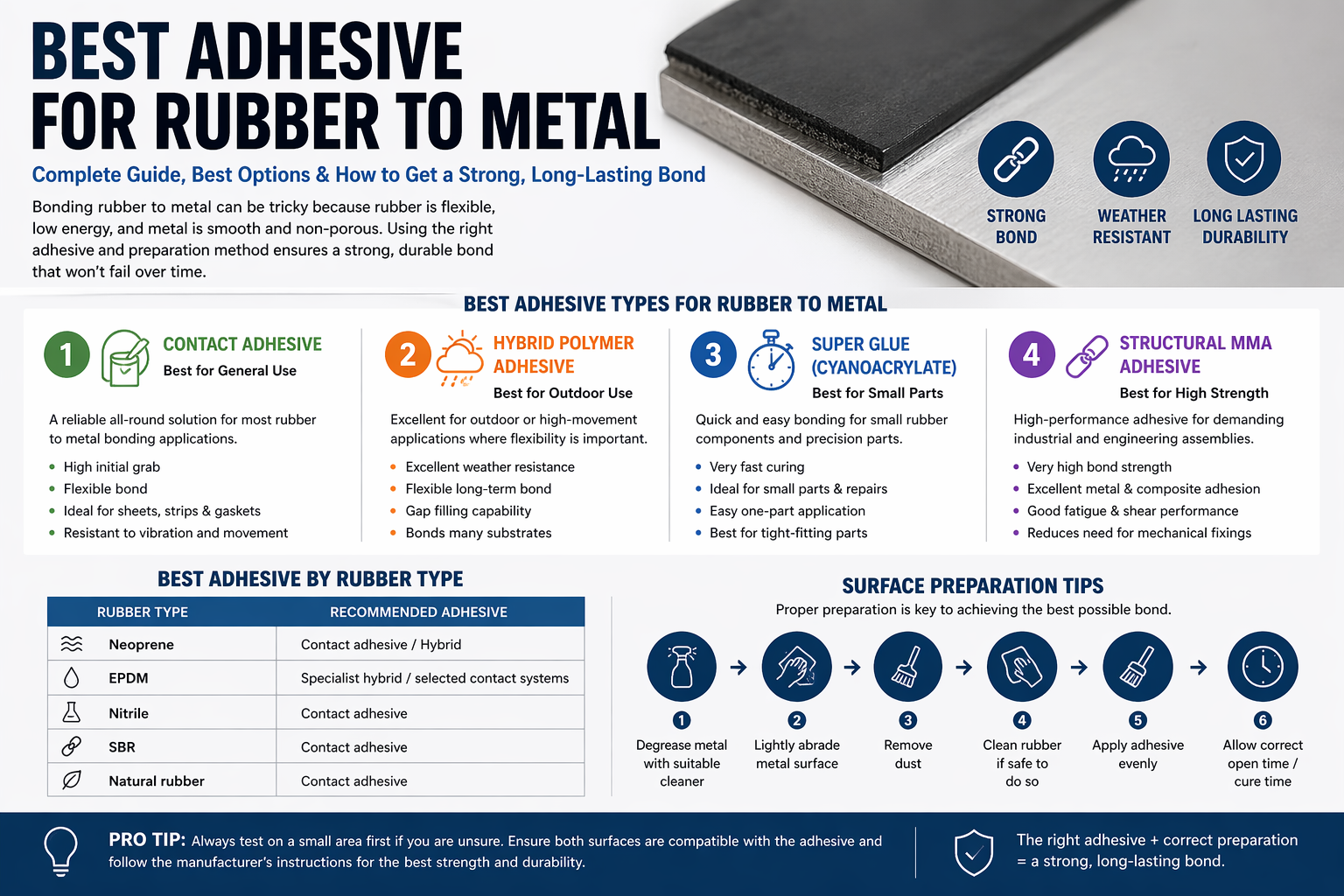
Quick Answer: What Is the Best Adhesive for Rubber to Metal?
For many industrial and trade applications, the best adhesive for rubber to metal is a contact adhesive or flexible hybrid polymer adhesive.
- Contact adhesive is ideal for rubber sheets, strips, trims, and large surface areas.
- Hybrid polymer adhesive is excellent where flexibility, outdoor weathering, or gap filling is needed.
- Cyanoacrylate (super glue) works for small, tight-fitting parts.
- Structural MMA or epoxy adhesives suit specialist high-strength engineering applications.
If bonding neoprene, nitrile, EPDM, or SBR rubber to steel or aluminium, the right preparation matters just as much as the glue.
Why Rubber to Metal Bonding Can Fail
Rubber surfaces can contain mould release agents, oils, or low-energy compounds that reduce adhesion. Metal may also be oily, oxidised, or too smooth.
Common failure reasons:
- No surface cleaning
- No abrasion of metal surface
- Wrong adhesive for flexible materials
- Bond line too thick or too thin
- Bond disturbed before full cure
- Outdoor UV/moisture exposure ignored
According to British Adhesives & Sealants Association, correct surface preparation is one of the most important factors in successful bonding systems.
Best Adhesive Types for Rubber to Metal
| Adhesive Type | Best For | Flexibility | Strength | Outdoor Use |
|---|---|---|---|---|
| Contact Adhesive | Rubber sheet, trims, wide areas | High | Medium | Good |
| Hybrid Polymer | Exterior joints, movement, gap filling | High | High | Excellent |
| Cyanoacrylate | Small components | Low | Medium | Fair |
| MMA Structural Adhesive | Engineering assemblies | Medium | Very High | Excellent |
| Epoxy Adhesive | Rigid static joints | Low | Very High | Good |
What Type of Rubber Are You Bonding?
Different rubber materials behave very differently when bonding to metal. Choosing the wrong adhesive can lead to peeling, swelling, or bond failure.
| Rubber Type | Common Uses | Recommended Adhesive |
|---|---|---|
| Neoprene Rubber | Gaskets, anti-vibration pads, seals | Bostik 2402, HB42 |
| EPDM Rubber | Outdoor seals, roofing, weatherproofing | Hybrid Polymer Adhesive |
| Nitrile (NBR) Rubber | Oil-resistant seals and pads | Bostik 2402 |
| SBR Rubber | General-purpose rubber sheet | Contact Adhesive |
| Silicone Rubber | High-temperature seals | Specialist silicone adhesive |
| Natural Rubber | Flexible pads and trims | Contact adhesive or CA glue |
For outdoor rubber seals and flexible movement joints, hybrid polymer adhesives often outperform rigid epoxies.
1. Contact Adhesive: Best for Rubber Sheets, Strips & Large Areas
For many users, the best adhesive for rubber to metal is a solvent-based contact adhesive such as Bostik 2402. 2402 is a two part solvent adhesive designed specifically for inflatable boats and rubber including neoprene, nitrile, butyl, polyurethane and natural.
Ideal for:
- Rubber strips onto steel frames
- Neoprene sheet to aluminium panels
- Rubber linings
- Seals and gaskets
- Marine and automotive repairs
Benefits:
- Flexible bond line
- Strong grab once joined
- Excellent for large surface areas
- Proven rubber bonding performance
See our guide on Bostik 2402 Adhesive for more details.
Buy Bostik 2402 Rubber Adhesive
2. Hybrid Polymer Adhesive: Best for Outdoor Use
If the bonded parts expand, vibrate, or sit outside in rain and temperature swings, hybrid polymer adhesives are often better than rigid systems. Hybrid polymer adhesives generally bond best to medium and higher surface energy rubbers, especially where flexibility and weather resistance are important.
Ideal for:
- External trims
- Vehicle conversions
- Metal doors with rubber buffers
- Construction joints
- Aluminium frames with rubber seals
- Outdoor panel edging
Example Products:
- HB42 Ultimate Sealant & Adhesive – a versatile all-in-one hybrid polymer adhesive with strong grab, flexibility, and excellent adhesion to many common building materials. Great for trims, rubber strips, and general external bonding.
- Arbomeric MP20 / ARBO hybrid systems – ideal where long-term movement capability and weather sealing are important, especially in construction-style joints.
Benefits:
- Excellent weather resistance
- Flexible long-term bond
- Gap filling ability
- Good adhesion to many substrates
- Lower brittleness than epoxies or super glues
Real World Example:
Bonding a neoprene rubber strip onto a painted steel gate frame where the frame flexes in hot/cold weather. A hybrid polymer adhesive is often a smarter choice than a rigid glue that may crack over time.
Important Note on EPDM Rubber: EPDM rubber can vary significantly between manufacturers. Some grades bond extremely well with hybrid polymer adhesives, while others containing surface treatments or release agents may require abrasion and thorough cleaning before bonding.
3. Super Glue: Best for Small Rubber Components
Cyanoacrylate adhesives can bond small rubber pads, feet, seals, and precision parts quickly.
Best for:
- Small tight-fitting parts
- Fast repairs
- Bench assembly work
- Rubber feet onto metal housings
- Small seals or grommets
- Light production assembly
Example Product:
- Permabond 105 Cyanoacrylate Adhesive – a fast-curing industrial super glue suitable for bonding rubber, metal, and many plastics. Ideal where speed and neat application matter. Excellent for small rubber pads, bump stops, seals, and workshop repairs.
–> When Should You Use POP Primer?
Some rubbers and plastics are naturally difficult for standard cyanoacrylate adhesives to bond because they have very low surface energy. A polyolefin primer (POP primer) can dramatically improve adhesion on these difficult materials. POP primer is commonly recommended alongside Permabond 105 when bonding:
- Polypropylene (PP)
- Polyethylene (PE)
- Thermoplastic rubber (TPR)
- Thermoplastic elastomers (TPE)
- Some EPDM rubber grades
- Certain low-energy synthetic rubbers
POP primer is usually unnecessary on standard neoprene, nitrile (NBR), natural rubber, steel, or aluminium where Permabond 105 often bonds successfully without priming.
Benefits:
- Very fast fixture time
- Easy one-part application
- Strong bond on close-fitting parts
- Clean, precise application for small areas
Real World Example:
Reattaching a small rubber foot onto a metal machine cover or bonding a nitrile rubber pad onto a tool bracket where the parts fit closely together.
Less suitable for:
- Outdoor movement
- Thick bond lines
- Large flexible sheets
- Constant water immersion
- Heavy peel stress applications
4. Structural Adhesives: High Strength Engineering Use
For specialist industrial assemblies, MMA adhesives such as the ITW Plexus range can bond certain rubber-backed metals or engineered composites where high strength is needed.
Best for:
- Engineered panels with rubber isolation layers
- Rubber-faced metal brackets
- Composite structures with bonded rubber sections
- Transport, marine, and vehicle assemblies
- High-load parts where screws or rivets are undesirable
Example Products:
- Plexus MA300 – fast-curing structural MMA adhesive, ideal where quick handling strength is needed.
- Plexus MA310 – longer working time version, useful for larger assemblies needing more positioning time.
- Plexus MA420 – tougher grade for demanding industrial bonding applications.
Real World Examples:
- Bonding an aluminium access panel with a neoprene isolation strip to reduce vibration.
- Securing rubber-backed steel wear plates inside machinery housings.
- Bonding composite covers onto metal frames where a rubber damping layer is included.
- Vehicle body assemblies using metal brackets with anti-rattle rubber interfaces.
Benefits:
- Very high structural strength
- Excellent adhesion to metals and composites
- Better fatigue resistance than many rigid systems
- Can reduce need for welding or mechanical fixings
Important Note:
MMA adhesives are usually best when the rubber is part of a designed assembly or bonded backing layer, rather than loose flexible sheet rubber. For simple rubber strip or gasket bonding, contact or hybrid adhesives are often more suitable. For high-strength structural bonding applications, compare Plexus MA300 vs MA310 to understand which MMA adhesive is best for fast assembly or longer working time.
Which Product Should You Choose?
Choose contact adhesive if you need to bond rubber sheet or strip onto metal.
Choose hybrid polymer if movement or weather is involved.
Choose super glue for small components.
Choose structural adhesive for engineered assemblies.
If unsure, contact us with:
- Rubber type
- Metal type
- Indoor or outdoor use
- Bond area size
- Load or movement involved
We can usually recommend the best adhesive for rubber to metal quickly.
❗ Rubber Types That Can Be More Difficult
Some rubbers are naturally lower surface energy or contain additives that reduce adhesion.
These may require specialist adhesives or testing first:
- Silicone rubber
- PTFE-backed rubber materials
- Highly plasticised rubbers
- Oily or wax-heavy rubber compounds
- Certain thermoplastic elastomers (TPE/TPR)
For these materials, specialist primers, cyanoacrylates, or structural acrylic adhesives may sometimes perform better than hybrid polymers.
Surface Preparation for Rubber to Metal Bonding
Even the best adhesive for rubber to metal can fail if the surfaces are poorly prepared.
Degrease Both Surfaces
- Use isopropyl alcohol (IPA) or a suitable cleaner
- Remove:
- Oils
- Dust
- Mould release agents
- Fingerprints
- Wax contamination
Abrade the Metal Surface
- Use 80 to 120 grit abrasive paper
- Helps create a mechanical key for the adhesive
- Particularly beneficial on:
- Aluminium
- Stainless steel
- Painted metal surfaces
Check the Rubber Surface
- Some rubbers contain release agents or surface oils that reduce adhesion
- Light abrasion can improve bonding on:
- Neoprene
- SBR rubber
- Nitrile (NBR)
- EPDM rubber
Allow Proper Cure Time
- Avoid stressing the bond too early
- Cure speed can be affected by:
- Temperature
- Humidity
- Adhesive thickness
- Airflow
Test Difficult Materials First
- Some rubbers are naturally harder to bond, including:
- Silicone rubber
- TPE/TPR materials
- Oily rubber compounds
- PTFE-backed materials
- Primer or specialist adhesives may be required
Final Verdict
For most practical applications, the best adhesive for rubber to metal is still a quality contact adhesive, especially for sheets, strips, and trims. Where movement or weather exposure matters, hybrid polymer adhesives often win. For rubber sheet, sponge rubber, and gasket materials, browse our full rubber materials range including neoprene, EPDM, nitrile, and SBR grades.