
An in-depth, practical and technical guide to selecting, specifying and using structural bonding systems in the structural adhesives UK market.
Table of Contents
- Introduction: Why Structural Bonding Has Transformed UK Fabrication
- What Are Structural Adhesives?
- How Structural Adhesives Actually Work
- Why Structural Adhesives Are Replacing Welding & Bolting
- Types of Structural Adhesives Explained
- Substrate Compatibility Guide
- Surface Preparation & Priming
- Joint Design & Load Distribution
- Cure Time, Open Time & Environmental Performance
- Structural Adhesive Bonding vs Mechanical Fixings
- Common Failure Causes
- Choosing the Right Structural Adhesive
- Structural Adhesives UK: Trade Buying Considerations
- Application Case Studies
- Structural Adhesive Chemistry Comparison Table
- Industry Standards & Compliance Considerations
- Long-Term Durability & Environmental Exposure
- Frequently Asked Questions
- Final Summary: Structural Adhesives UK
1. Introduction: Why Structural Bonding Has Transformed UK Fabrication
Across construction, signage, transport manufacturing, marine, and industrial fabrication, structural bonding has quietly replaced mechanical fastening in thousands of applications.
Where fabricators once welded brackets or drilled and bolted panels, many now use structural adhesives to create permanent, load-bearing joints.
The growth of lightweight materials, composite panels and mixed-material assemblies has accelerated demand across the structural adhesives UK market. Engineers increasingly need bonding systems that:
-
Join dissimilar materials
-
Reduce overall weight
-
Eliminate corrosion points
-
Absorb vibration
-
Improve aesthetic finish
Structural bonding is no longer a specialist technique. It is mainstream engineering practice.
2. What Are Structural Adhesives?
Structural adhesives are high-performance bonding systems designed to create permanent joints capable of carrying significant loads over long periods.
They differ from:
-
General construction adhesives
Structural adhesives are formulated specifically for strength, durability and stress distribution.
In simple terms:
A sealant keeps water out.
A structural adhesive holds materials together under load.
In the structural adhesives UK sector, the most common chemistries are:
Each has advantages depending on substrate, flexibility requirements and environmental exposure.
3. How Structural Adhesives Actually Work
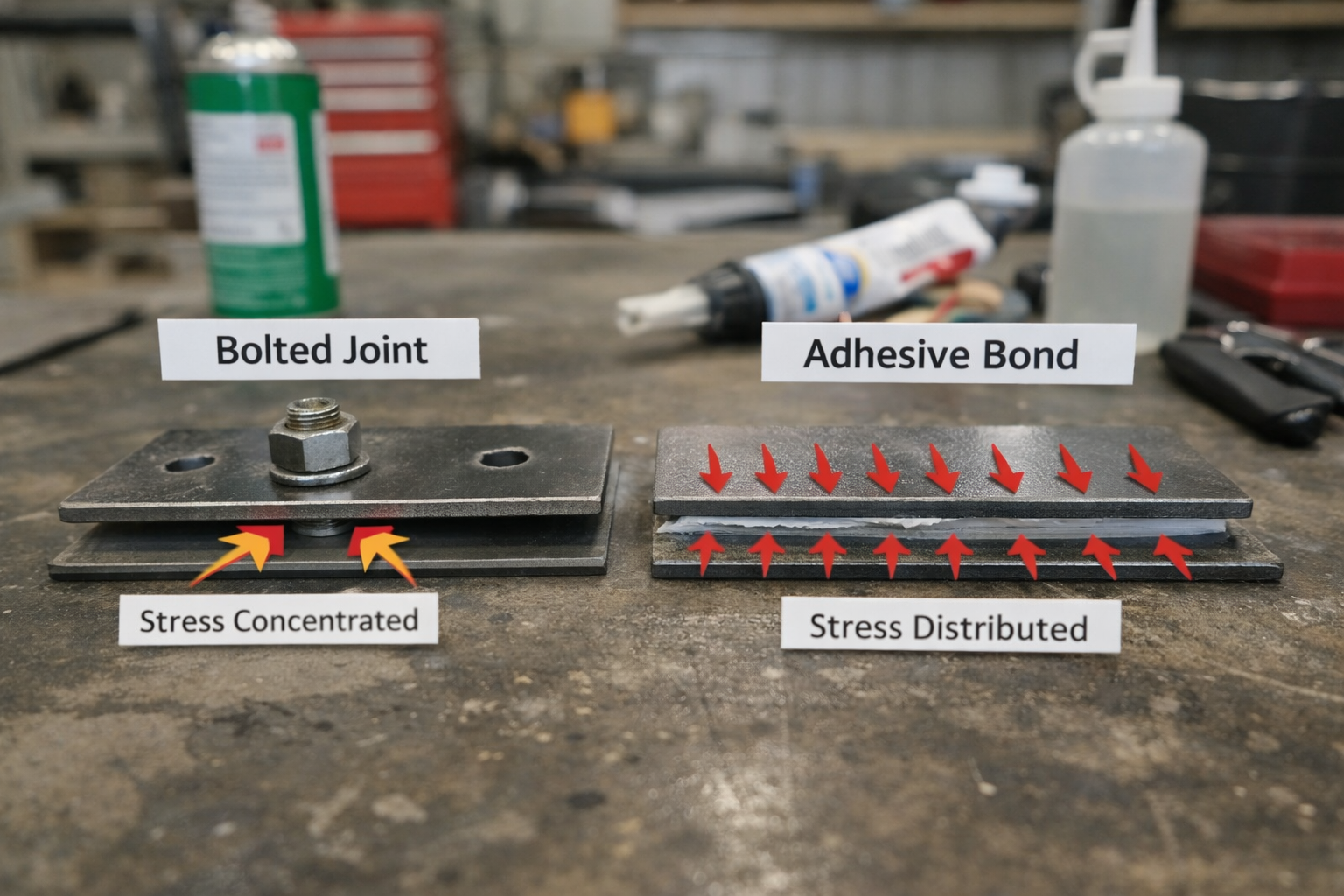
When two materials are bonded with a structural adhesive, three things happen:
1. Mechanical Interlocking
The adhesive flows into microscopic pores and surface irregularities.
2. Chemical Adhesion
At a molecular level, the adhesive interacts with the substrate surface.
3. Stress Distribution
Instead of concentrating force at bolt holes or weld seams, the adhesive spreads load evenly across the entire bonded area.
This stress distribution is the reason structural adhesives often outperform mechanical fixings in fatigue resistance.
For technical background on surface energy and adhesion principles, you can reference: ScienceDirect Topic: Adhesion and Surface Energy
https://www.sciencedirect.com/topics/engineering/adhesion
4. Why Structural Adhesives Are Replacing Welding & Bolting
Mechanical fasteners create what engineers call “stress risers.” These are concentrated points where force accumulates.
Structural adhesives remove that issue.
Key advantages:
-
No heat distortion (unlike welding)
-
No drilling required
-
Reduced galvanic corrosion
-
Improved aesthetics
-
Better vibration resistance
-
Ability to bond dissimilar materials
For a detailed comparison, see your cluster article:
👉 Structural Adhesive Bonding vs Mechanical Fixings
https://www.adsupply.co.uk/structural-adhesive-bonding-vs-mechanical-fixings/
5. Types of Structural Adhesives Explained
Understanding chemistry helps you choose correctly.
Methacrylate (MMA)
Common UK trade examples include:
As well as structural acrylic systems from Permabond such as TA4204, TA4205 and TA4611.
These products are widely used across the structural adhesives UK market where strong bonding to metals, plastics and mixed substrates is required, particularly in applications where surface preparation may be inconsistent or difficult to control.
Methacrylate’s are popular in the structural adhesives UK market because they:
-
Bond metals extremely well
-
Tolerate minimal surface prep
-
Handle vibration
-
Cure quickly
-
Fill gaps effectively
They are especially common in:
-
Aluminium fabrication
-
Panel bonding
-
Sign manufacturing
-
Marine assemblies
For product comparison:
👉 Plexus MA300 vs MA310
https://www.adsupply.co.uk/plexus-ma300-vs-ma310/
For selection guidance:
👉 Choosing the Right Plexus Structural Adhesive
https://www.adsupply.co.uk/choosing-the-right-plexus-structural-adhesive/
Structural Acrylic Adhesives (Permabond Systems)
Structural acrylic adhesives from Permabond are designed to deliver high-strength bonding across a wide range of substrates, including metals, composites and certain plastics.
Compared to traditional MMA systems, these adhesives are often selected where:
Surface preparation is inconsistent or difficult to control
A primer-free or reduced-prep solution is preferred
Mixed material assemblies are involved
Controlled cure speed and handling time are required
Products such as Permabond TA4204, TA4205 and TA4611 are commonly used in fabrication, transport manufacturing and general industrial bonding applications.
They offer:
Strong structural performance
Good adhesion to metals and plastics
Improved tolerance to real-world surface conditions
Reliable performance in production environments
For many trade users in the structural adhesives UK market, Permabond systems provide a practical alternative to traditional methacrylate adhesives.
Structural Adhesive Comparison: Plexus vs Permabond vs Epoxy vs Polyurethane
Below is a practical comparison of the most common structural adhesive systems used across the structural adhesives UK market.
| Property | Methacrylate (Plexus) | Structural Acrylic (Permabond) | Epoxy | Polyurethane |
|---|---|---|---|---|
| Typical Products | Plexus MA300, MA310 | Permabond TA4204, TA4611 | Araldite, ET500 | Bostik 3206 |
| Metal Bond Strength | Excellent | Excellent | Excellent | Good |
| Plastic Bonding | Very Good | Excellent | Good | Moderate |
| Surface Prep Required | Low | Low–Moderate | High | Moderate |
| Gap Filling | Excellent | Good–Very Good | Moderate | Good |
| Flexibility | Moderate | Moderate | Low | High |
| Vibration Resistance | Excellent | Very Good | Low–Moderate | Excellent |
| Cure Speed | Fast | Fast–Moderate | Slow–Moderate | Moderate |
| Ease of Use | High | High | Moderate | High |
| Primer Requirement | Rare | Sometimes (LSE plastics) | Often | Rare |
| Best For | Structural panel bonding, aluminium | Mixed materials, difficult surfaces | High heat & rigid structures | Flexible joints & movement |
| Trade Use Case | Signage, marine, fabrication | Industrial bonding, plastics, mixed assemblies | Steel structures, engineering | Construction, transport interiors |
How to Choose Between Them
There is no single “best” structural adhesive. The correct choice depends on your application:
- Plexus (Methacrylate) → Best for fast, high-strength bonding with minimal surface preparation
- Permabond (Structural Acrylic) → Best for mixed materials and difficult surfaces, especially where prep may vary
- Epoxy → Best for rigid, high-temperature structural applications
- Polyurethane → Best for flexible bonding and vibration-prone environments
Epoxy Adhesives
Epoxies are known for:
-
High heat resistance
-
Excellent metal-to-metal strength
-
Rigid, high-modulus bonds
They are commonly used in:
-
Load-bearing steel components
-
High-temperature environments
-
Structural composite applications
However, they are less flexible than methacrylate’s and may be less forgiving with dynamic loads. Carbon fibre is one of the most demanding substrates for structural bonding, which is why we’ve created a dedicated guide to the best adhesives for carbon fibre applications.
Polyurethane (PU)
Polyurethane structural adhesives offer:
-
Flexibility
-
Impact resistance
-
Good outdoor durability
They are suitable for:
-
Vibration-prone assemblies
-
Outdoor installations
-
Applications requiring movement tolerance
Hybrid / Structural Silicone Systems
Products such as Bostik Simson ISR 70-08 are often used for:
-
Façade panel bonding
-
Curtain wall systems
-
Exterior cladding
They provide:
-
Weather resistance
-
Elastic movement capability
-
Strong long-term outdoor performance
For more detail:
👉 Bostik Simson ISR 70-08 vs 70-03
https://www.adsupply.co.uk/bostik-simson-isr-70-08-vs-70-03/
6. Substrate Compatibility Guide
Choosing the right adhesive chemistry depends heavily on substrate type.
Below is a simplified compatibility overview.
| Substrate | Recommended Chemistry | Notes |
|---|---|---|
| Aluminium | Methacrylate | Minimal prep needed |
| Mild Steel | MMA or Epoxy | Abrasion recommended |
| Stainless Steel | Epoxy or MMA | Degrease thoroughly |
| ABS | MMA | Good compatibility |
| Polycarbonate | MMA | Avoid stress cracking |
| PE / PP | Specialised Acrylic (Permabond) + Primer | Low surface energy plastics require specialist systems |
For low surface energy plastics such as polyethylene and polypropylene, specialist systems from Permabond can provide improved adhesion performance when used with appropriate primers such as Permabond TA4611.
For deeper application-specific guides:
👉 Best Adhesive for Metal to Metal
https://www.adsupply.co.uk/best-adhesive-for-metal-to-metal/
👉 Best Adhesive for Metal to Plastic
https://www.adsupply.co.uk/best-adhesive-for-metal-to-plastic/
👉 Best Adhesive for Aluminium to Plastic
https://www.adsupply.co.uk/best-adhesive-for-aluminium-to-plastic/
👉 Best Adhesive for Aluminium to Plastic
Best Adhesive for Aluminium to Wood (Exterior Use)
7. Surface Preparation & Priming
Even the best products in the structural adhesives UK market will fail if applied to contaminated or poorly prepared surfaces.
Most bond failures are not adhesive failures. They are preparation failures.
Why Surface Prep Matters
Adhesives bond to surfaces, not dirt, oil, oxidation or release agents.
If a substrate is:
-
Oily
-
Oxidised
-
Coated
-
Dusty
-
Smooth and low-energy such as PP or PE
The adhesive may not form proper chemical adhesion. Low surface energy plastics often require adhesion promoters such as primers. In these cases, specialist systems from Permabond, used in combination with polyolefin primers, are commonly specified to achieve reliable structural bonding.
Standard Surface Preparation Steps
For most metals:
-
Degrease with a suitable solvent or IPA wipe
-
Abrade lightly (e.g., 120–180 grit)
-
Remove dust
-
Bond within recommended open window
For aluminium specifically: Oxide layers form quickly. Abrade and bond promptly.
For plastics: Identify whether the plastic is high or low surface energy.
High surface energy plastics:
-
ABS
-
Polycarbonate
-
PVC
Low surface energy plastics:
-
Polyethylene (PE)
-
Polypropylene (PP)
Low surface energy plastics often require adhesion promoters such as primers.
When Is Primer Required?
Not all structural adhesives require primer.
Methacrylate’s like Plexus are often chosen because they tolerate minimal prep.
However, primer may be required when:
-
Bonding PE or PP, you can use POP primer when using super glue
-
Substrate has unknown contamination
-
Surface is extremely smooth
-
Manufacturer technical data sheet specifies it
- To improve bond for stainless steel to aluminium, you can use Plexus PC 120 primer
If in doubt, always consult the TDS or contact our team for advice.
8. Joint Design & Load Distribution
Structural adhesives are strong, but joint geometry determines performance.
Poor joint design can reduce bond strength dramatically.
Best Practice Joint Types
Lap Joint
Most common and strongest configuration.
Shear stress is evenly distributed.
Scarf Joint
Angled joint that increases bonding area.
Flanged Joint
Often used in panel bonding and cladding systems.
Avoid Peel Stress
Adhesives are strongest in shear, weaker in peel.
Design joints so loads:
-
Act along the bond line
-
Avoid prying forces
-
Avoid point loading
If a joint is likely to experience peel, consider:
-
Increasing bonded area
-
Adding mechanical reinforcement
-
Using a more flexible adhesive chemistry
Gap Size Matters
Structural adhesives often perform best within specific bond line thickness ranges.
Too thin: Not enough adhesive to distribute stress.
Too thick: Reduced mechanical performance.
Always follow manufacturer guidance.
9. Cure Time, Open Time & Environmental Performance
This is where many trade buyers make incorrect assumptions.
Open Time (Working Time)
This is the period after mixing during which the adhesive can still be applied.
Example: Plexus MA300
Short working time, suitable for fast assembly.
Plexus MA310
Longer working time, suitable for larger assemblies.
See comparison: 👉 Plexus MA300 vs MA310
https://www.adsupply.co.uk/plexus-ma300-vs-ma310/
Fixture Time (Handling Strength)
The time required before the joint can be moved carefully.
Not the same as full cure.
Full Cure
Full mechanical strength can take:
-
Several hours
-
24 hours
-
Occasionally longer
Temperature affects cure speed significantly.
Service Temperature
Different chemistries have different operating ranges.
Typical ranges:
Methacrylate: -40°C to +120°C (varies by product)
Epoxy: Often higher temperature resistance
Polyurethane: Lower maximum temperature but better flexibility
Always consult the technical data sheet for exact figures.
Chemical & Environmental Resistance
Consider exposure to:
-
UV
-
Saltwater
-
Oils
-
Fuels
-
Cleaning chemicals
For example: Methacrylate’s perform well in marine environments.
Epoxies perform well in high-heat conditions.
10. Structural Adhesive Bonding vs Mechanical Fixings
Mechanical fixings are familiar. Adhesives are engineered.
Mechanical fasteners:
-
Concentrate load at bolt points
-
Require drilling
-
Can introduce corrosion pathways
-
Add weight
Structural bonding:
-
Distributes load evenly
-
Eliminates drilling
-
Reduces weight
-
Creates sealed joints
For detailed breakdown: 👉 Structural Adhesive Bonding vs Mechanical Fixings
https://www.adsupply.co.uk/structural-adhesive-bonding-vs-mechanical-fixings/
In many modern applications, hybrid systems are used: Adhesive + mechanical fastener during cure.
11. Common Failure Causes
Understanding failure modes helps prevent them.
1. Poor Surface Preparation
Most common cause.
2. Incorrect Mix Ratio
Two-part systems must mix correctly.
3. Movement Before Cure
Disturbs bond line.
4. Excessive Bond Gap
Reduces structural integrity.
5. Environmental Mismatch
Adhesive not suited for temperature or exposure.
Real-World Example
A fabricated aluminium frame bonded with MMA performs well.
However, if bonded to oily galvanised steel without abrasion, failure can occur at the interface.
The adhesive did not fail. The preparation did.
12. Choosing the Right Structural Adhesive
Before selecting a product from the structural adhesives UK market, ask:
-
What substrates are being joined?
-
Is flexibility required?
-
What temperature range will the joint experience?
-
How fast must it cure?
-
Is UV exposure involved?
-
Is primer acceptable?
Where surface preparation is limited or substrates are inconsistent, structural acrylic systems from Permabond can offer a more forgiving solution compared to traditional epoxy systems, while still delivering strong structural performance.
👉 Structural Adhesives Category
https://www.adsupply.co.uk/product-category/adhesives/structural-adhesives/
13. Structural Adhesives UK: Trade Buying Considerations
When sourcing structural adhesives UK wide, trade buyers should consider:
1. Shelf Life
Structural adhesives have expiry dates.
2. Storage Conditions
Often 5°C to 25°C.
3. Cartridge Compatibility
50ml, 400ml and 600ml formats require correct guns.
4. Technical Support
A knowledgeable supplier helps prevent costly application errors.
5. Batch Traceability
Important for commercial contracts.
Not all suppliers provide equal support.
14. Application Case Studies
Case Study 1: Aluminium Sign Frame Bonding
Scenario:
A signage fabricator needs to bond aluminium frame sections to composite panels without visible fixings.
Challenges:
-
Outdoor exposure
-
Wind loading
-
Aesthetic finish required
-
Dissimilar material expansion
Solution:
Methacrylate structural adhesive such as Plexus MA300 or MA310.
Why:
-
Excellent aluminium adhesion
-
Good vibration resistance
-
Tolerates differential expansion
-
Fast handling strength
For deeper product comparison: 👉 Plexus MA300 vs MA310
https://www.adsupply.co.uk/plexus-ma300-vs-ma310/
Case Study 2: Steel Bracket to Plastic Housing
Scenario:
Industrial enclosure manufacturer bonding steel mounting brackets to ABS housing.
Challenges:
-
Plastic substrate
-
Load-bearing bracket
-
Indoor industrial environment
Solution:
Methacrylate adhesive with correct surface prep.
For substrate guidance: 👉 Best Adhesive for Metal to Plastic
https://www.adsupply.co.uk/best-adhesive-for-metal-to-plastic/
Key consideration:
Ensure ABS is degreased and lightly abraded.
Case Study 3: Aluminium to Plastic Panel Assembly
Scenario:
Lightweight transport interior components.
Challenges:
-
Vibration
-
Mixed materials
-
Limited mechanical fixing points
Solution:
Structural bonding system that allows stress distribution.
See: 👉 Best Adhesive for Aluminium to Plastic
https://www.adsupply.co.uk/best-adhesive-for-aluminium-to-plastic/
15. Structural Adhesive Chemistry Comparison Table
Below is a simplified technical comparison for trade-level decision making.
| Property | Methacrylate (MMA) | Epoxy | Polyurethane |
|---|---|---|---|
| Metal Bond Strength | Excellent | Excellent | Good |
| Plastic Bonding | Very Good | Good | Moderate |
| Flexibility | Moderate | Low | High |
| Temperature Resistance | Moderate-High | High | Moderate |
| Surface Prep Sensitivity | Low-Moderate | High | Moderate |
| Cure Speed | Fast | Medium | Medium |
16. Industry Standards & Compliance Considerations
In some sectors, structural bonding may need to align with industry guidance or project specifications.
Examples include:
-
Transport interior regulations
-
Marine environment durability
-
Cladding system performance requirements
-
Fire resistance considerations
While most general fabrication projects do not require formal adhesive certification, commercial projects often require:
-
Technical data sheets
-
Batch traceability
-
Performance data
17. Long-Term Durability & Environmental Exposure
A common question from trade buyers:
“Will the bond last?”
When correctly specified and applied, structural adhesives can last decades.
However, performance depends on:
UV Exposure
Some chemistries may yellow or degrade if fully exposed.
Thermal Cycling
Repeated expansion and contraction stresses joints.
Moisture
Marine and exterior exposure require appropriate chemistry selection.
Chemical Exposure
Industrial settings may expose joints to oils or cleaning agents.
Always verify service environment against the TDS.
18. Frequently Asked Questions
Are structural adhesives stronger than welding?
In certain configurations, yes.
They distribute stress across the bond area and eliminate heat distortion. However, joint design determines overall performance.
Do structural adhesives require primer?
Not always.
Methacrylate’s often tolerate minimal prep.
Low surface energy plastics may require adhesion promoters.
Can structural adhesives bond aluminium to plastic?
Yes.
Methacrylate systems are commonly used for this.
See application guide:
https://www.adsupply.co.uk/best-adhesive-for-aluminium-to-plastic/
How long do structural adhesives take to cure?
Working time may range from 3 minutes to 30+ minutes.
Full cure may take several hours.
Always check manufacturer specifications.
Are structural adhesives waterproof?
Most structural adhesives are water resistant once cured.
However, suitability for continuous immersion should be confirmed in the TDS.
Can I replace bolts entirely with adhesive?
In many cases, yes.
In high-load structural assemblies, a hybrid system may be recommended.
19. Final Summary: Structural Adhesives UK – Making the Right Choice
When purchasing structural adhesives UK wide, trade buyers should prioritise:
-
Reliable stock availability
-
Clear technical data
-
Correct dispensing equipment
-
Appropriate cartridge sizes
-
Shelf life transparency
Structural adhesives are not generic consumables. They are engineered systems.
Working with a knowledgeable supplier reduces risk and costly fabrication errors.
Explore available products here:
👉 Structural Adhesives Category
https://www.adsupply.co.uk/product-category/adhesives/structural-adhesives/
20. Final Summary: Structural Adhesives UK – Making the Right Choice
The structural adhesives UK market continues to expand as industries move toward lightweight fabrication, composite construction and mixed-material assemblies.
Structural adhesives provide:
-
Even stress distribution
-
Corrosion resistance
-
Vibration tolerance
-
Improved aesthetics
-
Reduced weight
However, successful bonding depends on:
-
Correct chemistry selection
-
Proper surface preparation
-
Suitable joint design
-
Environmental awareness
By understanding adhesive types, substrate compatibility and application best practice, UK trade buyers can confidently select systems that deliver long-term performance.
For professional-grade structural adhesives, detailed technical guidance and reliable UK dispatch, explore:
👉 Structural Adhesives
https://www.adsupply.co.uk/product-category/adhesives/structural-adhesives/