
Description
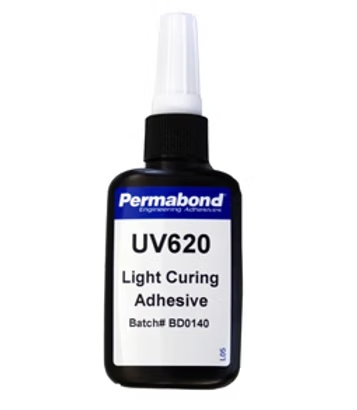
Permabond UV620 is a single-component UV-curable adhesive designed for applications where high bond strength, optical clarity and an attractive finished appearance are essential.
It offers excellent adhesion to glass and metal, making it ideal for bonding glass shelves, metal fittings, decorative glass components and architectural assemblies. Once cured, the adhesive remains clear and resistant to yellowing, helping preserve the appearance of visible bond lines.
Unlike rigid glass adhesives that may struggle when dissimilar materials expand and contract at different rates, UV620 provides more than 80% elongation. This allows the cured adhesive to better accommodate differential thermal movement between glass and metal.
The adhesive remains liquid until exposed to the correct UV light, giving the user time to position and align components before initiating the cure. Once illuminated with a suitable UV lamp, fixture can be achieved within seconds.
Key features and benefits
- High-strength UV-curable adhesive
- Designed for bonding glass to metal
- Excellent adhesion to glass and crystal
- Optically clear cured appearance
- Resistant to yellowing
- High elongation to accommodate thermal expansion and contraction
- Single-part formulation with no mixing required
- Solvent-free, 100% solids formulation
- Cures on demand using a suitable UV lamp
- Fast curing with low-power UV lamps
- Suitable for visible and decorative bond lines
Typical applications
Permabond UV620 is suitable for applications including:
- Glass furniture
- Glass shelves and display units
- Glass-to-metal brackets and fittings
- Architectural glass products
- Decorative glass assemblies
- Crystal ornaments
- Glass showcases and cabinets
- Metal fittings bonded to transparent glass
- Interior glass components
- Display and point-of-sale assemblies
Why choose Permabond UV620?
UV620 is particularly useful where the bonded assembly must remain visually clean and attractive. Its optical clarity helps create discreet bond lines, while its flexibility reduces the risk of stress building up between glass and metal as temperatures change.
It also offers much faster processing than traditional two-part structural adhesives. Components can be positioned accurately, checked and then cured only when the assembly is ready.
How to use
- Ensure all bonding surfaces are clean, dry and free from grease, dust and contamination.
- Apply a controlled amount of Permabond UV620 to one surface.
- Assemble and align the components.
- Expose the bond line to a suitable UV lamp operating within the recommended wavelength range.
- Allow sufficient exposure for the adhesive to cure fully.
At least one substrate must transmit the UV light needed to reach the adhesive. Cure speed will depend on the lamp intensity, wavelength, distance from the joint, adhesive depth and light transmission through the substrate.
Technical information
| Property | Typical value |
|---|---|
| Chemical composition | Methacrylate ester |
| Appearance | Colourless, clear |
| Viscosity at 25°C | 2,200–2,900 mPa·s |
| Specific gravity | 1.0 |
| Cure wavelength | 365–400 nm |
| Typical fixture time with low-power lamp | Approximately 5 seconds |
| Typical fixture time with LED lamp | Approximately 2 seconds |
| Typical fixture time with UV light guide | Approximately 1 second |
| Tensile strength | 16 N/mm² |
| Glass-to-steel tensile strength | 9–10 N/mm² |
| Elongation | Greater than 80% |
| Hardness | 60–75 Shore D |
| Refractive index when cured | Greater than 1.490 |
| Water absorption | Less than 4% |
Technical values are typical and may vary depending on joint design, surface preparation, bond gap and curing conditions.
Important application notes
- UV light must be able to reach the adhesive for curing to take place.
- At least one component should normally be transparent or sufficiently UV-transmissive.
- Test on coated, tinted, laminated or UV-blocking glass before production use.
- UV620 is designed for relatively thin, controlled bond lines.
- Ensure the selected UV lamp delivers the correct wavelength and sufficient intensity.
- Users should wear appropriate eye and skin protection when operating UV curing equipment.
- Always consult the current technical and safety data sheets before use.
Reviews
There are no reviews yet.